Physicists have discovered a triple black hole system for the first time, and their existence challenges long-held theories about how black holes form.
Many black holes have been found in binary systems, consisting of a black hole and a secondary object, such as a star or another black hole, according to Interesting Engineering on October 25.
In a new report published in the journal Nature , physicists from the Massachusetts Institute of Technology (MIT) and the California Institute of Technology (Caltech) describe the existence of a triple black hole system about 8,000 light years from Earth.
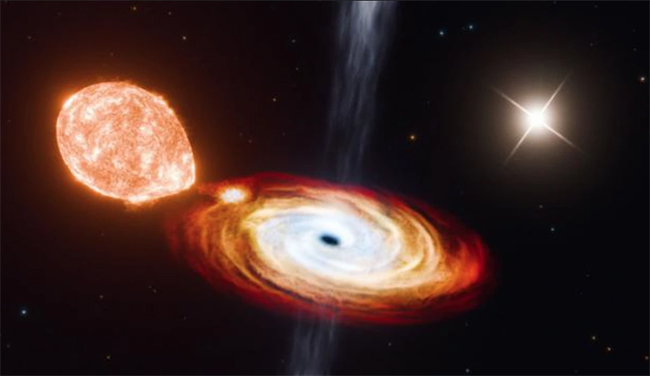
Graphical rendering of the concept of a triple black hole system. (Image: mit).
The new system consists of a central black hole that is devouring a small star at extremely close range. This star takes about six and a half days to complete an orbit around the black hole.
More surprisingly, experts also observed a second star orbiting the black hole at a greater distance. Physicists estimate that the third member would take up to 70,000 years to complete a full orbit around the central black hole.
The fact that a black hole's gravity can hold a celestial body at such a great distance raises many questions about its origin.
Black holes are thought to form after the explosion of a dying star, releasing a huge amount of energy and light before collapsing into an invisible black hole, known as a nova explosion.
However, the discovery by MIT and Caltech shows that if the black hole was born after a nova explosion, the second star should not have been present as it was.
To explain the triple black hole system, the team suspects the black hole formed through a gentler process, in which a star collapses directly but without releasing huge amounts of energy.
The triple black hole system may be the first evidence that a black hole can form from a less violent process .