Invisibility cloaks are no longer the stuff of science fiction , but recent advances in optical technology have brought us closer to real-life invisibility cloaks.
How does the invisibility cloak work?
At its core, cloaking technology relies on manipulating light waves , the very thing responsible for our visual perception. Researchers have developed innovative methods to bend and redirect light, effectively hiding objects from view.
But creating an invisibility cloak across the entire visual spectrum is no small challenge. Scientists have previously built stealthy fighter jets that are invisible to radar and thermal cloaks that hide soldiers from enemy thermal imaging. But hiding something from the naked eye as if it never existed requires some advanced and complex engineering.
Normally, when light interacts with an object, it either absorbs or reflects the light, making the object visible. Whereas 'invisibility' would require light to pass through an object undisturbed, as if it were not there. To achieve this, a cloaking device would need to redirect light from all directions around the object, so that it appears invisible from all angles.

Metamaterial is a type of artificial material whose properties depend more on its structure than on its composition.
Metamaterials , materials that have unique properties not found in nature, play a key role in creating invisibility cloaks. By designing these materials with carefully arranged nanostructures, scientists can control the behavior of light waves, allowing them to manipulate light around an object, making it appear invisible.
On the other hand, Metamaterials are also thin lenses that can converge light of different wavelengths into the same point, overcoming the limitations of traditional lenses.
Another method used to create invisibility cloaks is light redirection. These techniques require precise control of the speed, direction, and intensity of light waves to achieve the desired effect.
Example of invisibility cloak
Although invisibility cloaks are still very much an area of scientific research and development, there have been notable advances and demonstrations in the field.
Quantum Stealth

By stacking multiple lens-like layers with different lens distributions, the material can refract light at multiple angles, creating "dead spots" that block light from passing through and effectively conceal the subject while keeping the background unaffected.
In 2019, Hyperstealth Biotechnology, a Canadian manufacturer of military-grade camouflage uniforms, unveiled a prototype of 'quantum invisibility,' a paper-thin material that can bend light around it. What's more, the invisibility cloak doesn't just work on visible light, it can also block infrared and shortwave infrared, making it a broadband invisibility cloak.
Rochester Cloak
Developed in 2014 at the University of Rochester, it can operate in multiple directions in a 3D environment , thanks to a system of four lenses.
This means the device can hide an object from view regardless of the viewer's position relative to it. The team accomplished this feat by carefully choosing the type of lens, its power, and the distance between the lenses.
While the current device shows significant progress, there are still areas for improvement. First of all, it is impossible to turn this setup into a stealth suit because the optical system is complex and inflexible.
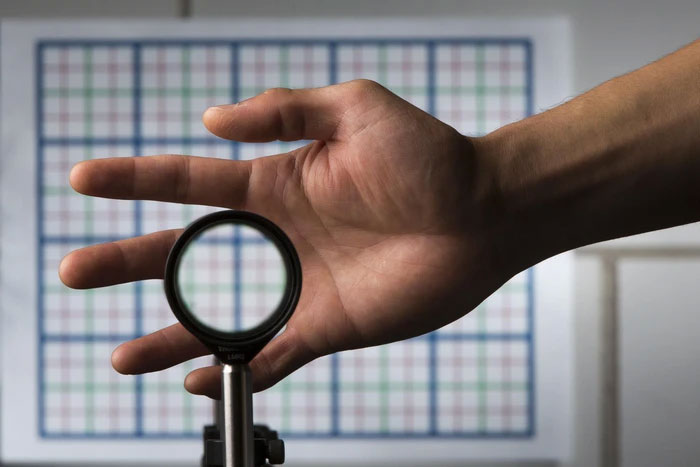
Besides solving the perspective problem, the 'Rochester cloak' allows the background to remain natural, without distorting the view around the object.
Invisibility cloak in front of security cameras
A group of Chinese students have managed to bypass security cameras with a groundbreaking invention. And the result is a shirt designed to make the wearer virtually invisible to AI-monitored cameras - InvisDefense .
InvisDefense possesses the ability to render a wearer invisible to surveillance cameras while remaining visible to the naked eye.
'AI security cameras are everywhere. They permeate our lives,' said Wei Hui, a computer science graduate student at Wuhan University who designed the cloak's core algorithm.
"We designed this product to be resistant to malware detection, to protect people's privacy and safety in certain situations."

The wearer is not detected as human by the AI-controlled security system.
During the day, cameras rely primarily on motion and contour recognition to identify human bodies. By decorating the surface of InvisDefense with a specially designed camouflage pattern, the vest can perfectly circumvent machine vision recognition algorithms, making it impossible for cameras to distinguish the wearer as a human.
When darkness falls, the challenge increases as the camera switches to infrared thermal imaging. To combat this, InvisDefense integrates irregularly shaped temperature-control modules on its interior surface, creating a unique thermal pattern that can fool the infrared camera.
Metal stealth

This flat Metalens is the first single lens that can focus the entire visible light spectrum – including white light – into a single point and at high resolution. It uses titanium dioxide nanofiber arrays to evenly focus all wavelengths of light and eliminate chromatic aberration.
A breakthrough in 2018 involved the use of titanium nanowires in metal tubes, allowing them to bend light to the extent necessary to achieve invisibility. While previous metamaterials have been unable to cover visible wavelengths of light, the combination of Metalens and metamaterials shows promise in extending invisibility to the visible light spectrum.
This advancement in metal technology opens the door to visible light cloaking devices, where light of different wavelengths can be manipulated to render objects invisible. While the technology is not yet fully developed, it is an important step towards achieving real-life invisibility cloaks in the near future.
Invisible Shield

According to Invisibility Shield Co., their shields work best when used on a uniform background.
The Invisibility Shield uses a precision-engineered array of lenses to cleverly manipulate light. By redirecting much of the light reflected from the subject away from the observer, it can effectively camouflage the person behind it. This redirected light is then spread sideways across the face of the shield, creating the illusion of a background.
The Future of Invisibility Cloaks
In the military, stealth technology could revolutionize stealth operations, rendering military assets invisible to radar or surveillance systems. Additionally, in the optics field, stealth technology could improve the effectiveness of telescopes, microscopes, and other imaging devices.
While we may not see Harry Potter-style invisibility cloaks anytime soon, there's no denying that the progress being made in this field is impressive. Ongoing research and collaboration between scientists, engineers, and materials experts promise even more breakthroughs in the future. Invisibility technology could one day become an integral part of our lives, revolutionizing various industries and changing the way we see the world.