Artificial intelligence (AI) is not a new concept. Famous inventor Adolph Whitman created AI-powered robots more than 100 years ago.
See also: For the first time, a robot with artificial intelligence passes the medical degree exam.
German scientist Adolph Whitman was a visionary in the field of AI and robotics. His most famous invention that pushed the boundaries of robotics was Occultus, developed in 1909. It was one of the first robots to understand human language. It could move on its own, respond to commands, and interact with humans in a way that was understandable.
Technological miracle
At the time of its creation, Occultus attracted widespread attention from the inventors because of its unparalleled capabilities compared to other robots of its time. Whitman enabled this robot to walk, move, talk, sing, whistle and laugh. With the appearance of a bearded man, Occultus was so similar to a human that it was indistinguishable from a meter away.
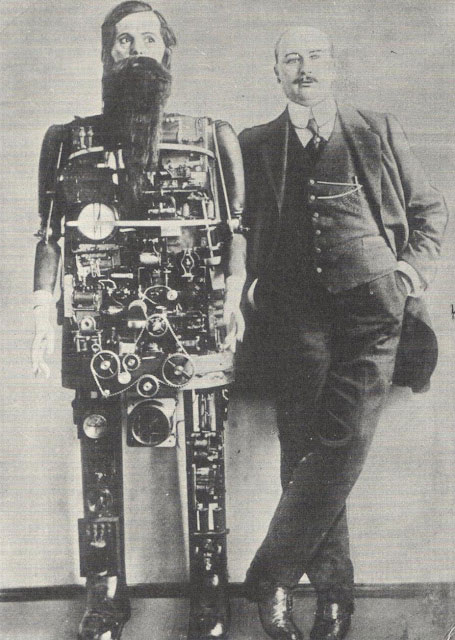
Rare photo of robot Occultus and its "father" Adolph Whitman. (Photo: History of Yesterday).
It is made up of many complex gears and machines. The chest is equipped with a number of turntables, but how these machines are controlled is a secret of the inventor. It is said that wireless waves are the magic behind Occultus. Each part of the robot is controlled by a small electric motor.
Most importantly, Occultus is equipped with a series of sensors and motors that allow it to move easily . Two cameras installed in its body allow the robot to detect surrounding objects as well as recognize faces. Additionally, it has four infrared proximity sensors located at each corner of its body that help it avoid colliding with other objects or people when moving around tight spaces.
Occultus also has an artificial intelligence engine that analyzes speech and makes decisions based on it. This allows Occultus to respond appropriately to human commands, as well as recognize simple gestures like waving or pointing.
Safety was a major consideration when Adolph Whitman designed Occultus. He included proximity sensors to detect if something or someone got too close to the robot and automatically shut down all motors until the threat was gone. These sensors also helped Occultus learn simple tasks without the risk of injury or damage from collisions.
In addition to being an engineering feat that paved the way for today's modern AI robotics technology, it had a significant impact on modern AI and inspired other scientists to pursue further innovation and advancement throughout the 20th century.
Whitman's creation also raised new ethical concerns, as it showed how far robots could be programmed without violating human rights or autonomy. This has been an important issue for researchers ever since, as technology advances at an unprecedented pace and robots become increasingly intelligent.
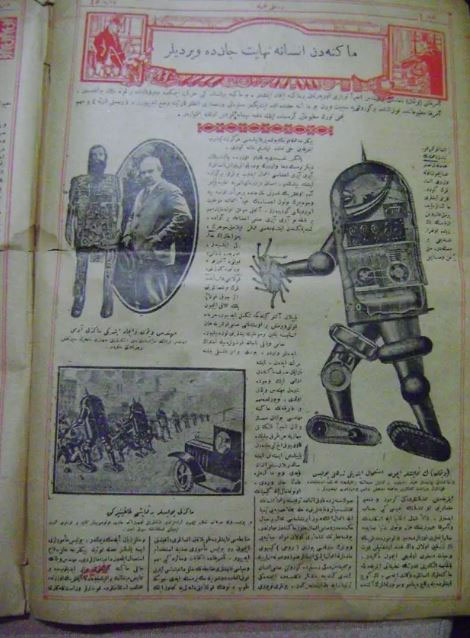
A Turkish newspaper article claims that Occultus was an early Ottoman Empire robot built as a gift for the Japanese under the name Alamet, but this information is unconfirmed. (Photo: CyberneticZoo)
The future of AI.
A century ago, Adolph Whitman's invention of the Occultus was a milestone in the history of AI. In the 21st century, AI-powered robots have made great strides, allowing them to become increasingly autonomous and capable of performing complex tasks without human assistance. This development has revolutionized many different industries and sectors, from healthcare to energy production, by automating labor-intensive processes.
Occultus-inspired robots are being used in a variety of industries, including manufacturing, healthcare, and customer service. For example, robotic arms are being used for repetitive manufacturing tasks on the factory floor; medical robots are being deployed for surgical procedures; and customer service bots are providing automated support services online or via chatbots.
In all of these cases, these machines can help improve efficiency, while freeing up workers to focus on higher-value activities like problem solving or customer relationship management.
However, the rise of automation has given rise to a number of ethical concerns. Primarily, there is a fear that robots could take over human jobs. Policymakers should therefore carefully consider the benefits and risks this poses to society as a whole.
