Have you ever thought that the Moon is the largest natural satellite in the Solar System? Discover this through the image below.

In the general sense, Moon is the natural satellite of the planets.The Earth's moon is just one of the natural satellites in the solar system.Photos: Some of their planets and moons (Pinterest).

According to statistics from Astronomy, the largest moon in the solar system is Ganymede, Jupiter (Jupiter) satellite with a diameter of 5268km.

Second in this satellite size race is Titan, Saturn satellite (Saturn) with a diameter of 5152km, only slightly worse than Ganymede.

Jupiter's Callisto also has a quite large diameter of 4821km.(Photo: Sea and Sky).
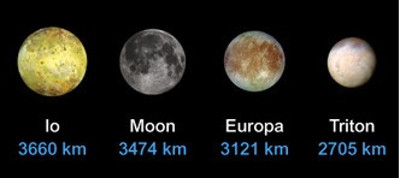
The next 4 positions are satellites with a diameter of about 3000-4000km, including Io 3643km and Jupiter's 3122km.The Earth's Moon has a relative size between the two satellites with a diameter of 3475km.The smallest of this group is Neptune's Neptune satellite with a diameter of 2707km (Astronomy data is 2700km), only half the size of the group of 3 satellites in the largest category above.(Photo: Astronomy).

Last in the top 11 largest satellites are 4 satellites approximately equal to Saturn and Uranus (Uranus): Rhea 1529km, Iapetus 1471km (Saturn), Titania 1578km, Oberon 1523km (Thien Vuong star).
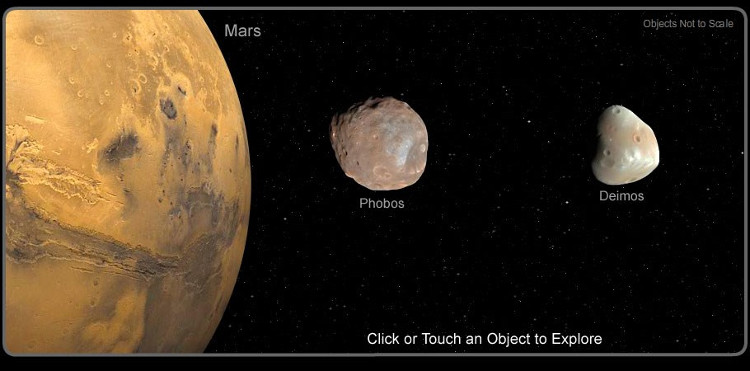
On the contrary, the two smallest champions in satellites are Mars' Moon (Mars), Phobos and Deimos with a diameter of only 22.2 and 12.4 km.(Photo: Sea and Sky).
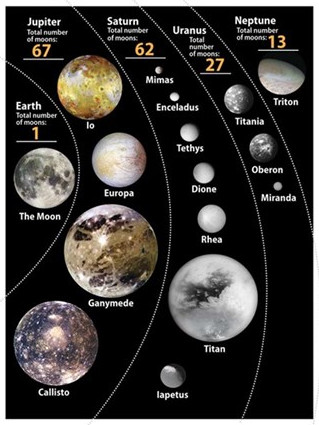
Review some planets with satellites in the solar system.(Photo: Astronomy).
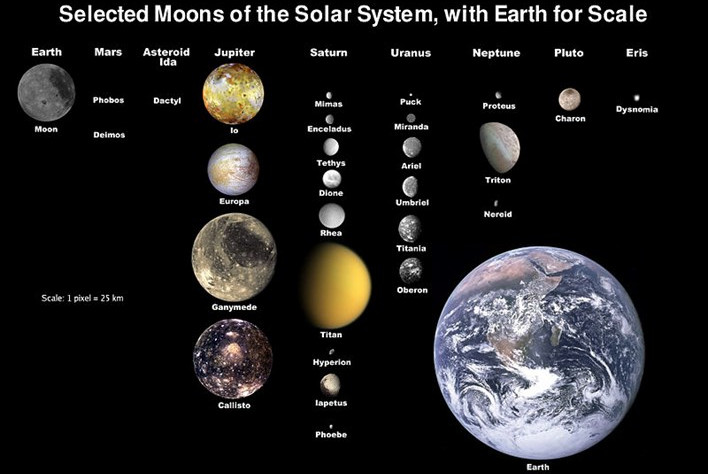
The image selects a number of natural satellites in the solar system and is relative to the Earth.(Photo: NASA).