Nebula is a Latin word meaning "cloud," but in an astronomical context, it refers to any celestial object that looks like a cloud when viewed through a telescope.
In the past, when telescopes were not as modern and powerful as they are today, the term was used to refer to galaxies such as Andromeda – our neighbor – and it was often called the "Andromeda Nebula".
However, with advancements in modern telescopes, we know that galaxies are not, and indeed are not, clouds; instead, they are made up of billions of stars. This means that astronomers now only use the term "nebula" for the "real" clouds—composed of gas and dust—that lie within galaxies.
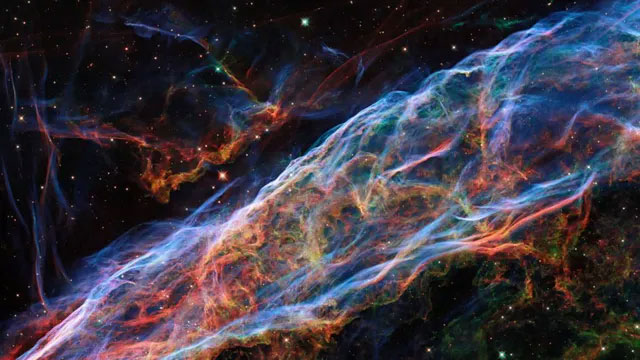
Nebulae are commonly found in interstellar space.
Where is the nebula located?
Nebulae are commonly found in interstellar space, also known as the interstellar medium . On average, this region contains only about one atom per cubic centimeter. However, in some places, the density can be significantly higher than this – high enough to be visible through telescopes and one of the most interesting aspects of astronomy. In fact, most of the images of nebulae we know today were taken by the Hubble telescope, such as the "Pillars of Creation".
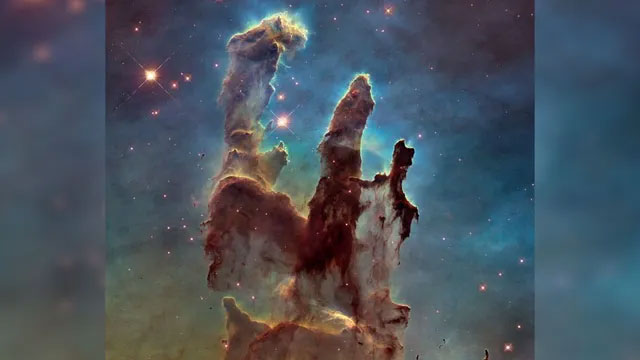
Pillars of Creation.
Based on data collected from space, we know that there are several different types of nebulae, depending on how they form and their composition. Most nebulae are primarily formed from gas, which can emit light from its own source, creating the colorful shapes we are so familiar with.
But other nebulae—such as the so-called "dark nebulae" —are composed primarily of cosmic dust, and instead of glowing, this dust blocks light from objects further away beyond it.
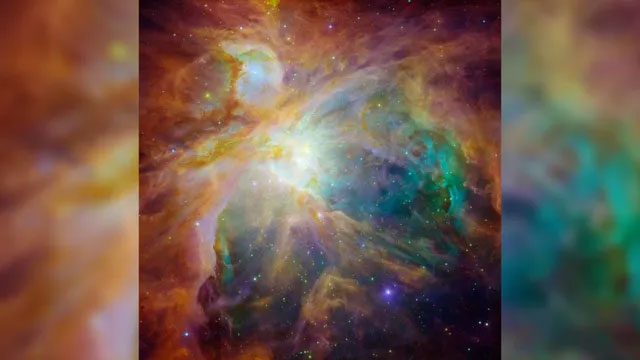
Most nebulae are formed primarily from gas.
The relationship between nebulae and stars
Nebulae play a crucial role in the life cycle of stars , both in their birth and death. Stars are born within dense clouds of gas, dust, and other matter inside diffuse emission nebulae, and these types of nebulae are often called " star nurseries."
The Pillars of Creation, photographed by Hubble, is also a nebula of this type. In addition, there's the well-known Orion Nebula – you may have even seen it yourself through a consumer telescope if you know how.
The primary force at work here is gravity, which causes the interstellar medium to continuously condense into a nebula, and gravity causes the masses within the nebula to collapse into stars.
At the end of a star's life cycle, we often encounter a different type of emission nebula. Stars like the Sun, when they end their lives, often transform into white dwarfs. But before becoming white dwarfs, they release massive clouds of gas, forming what are called "planetary nebulae."
Unlike diffuse emission nebulae, these nebulae have a more distinct shape, often circular. It was precisely because of this that William Herschel, the German-born British astronomer, mistakenly thought they were planets when he first observed them in the 1780s.
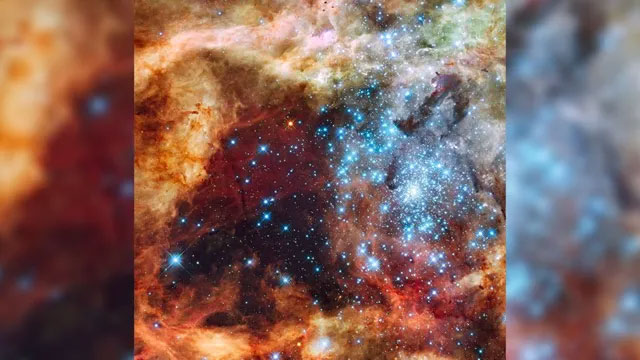
A spectacular image from Hubble reveals a giant "star nursery" in the Doradus 30 Nebula.
However, not all stars end their lifecycles so smoothly and peacefully. When a star has a mass much greater than that of the Sun, at the end of its life cycle it will explode as a supernova, and the debris from that explosion will form another type of nebula called a supernova remnant. The most famous of these is the Crab Nebula, recorded by Chinese and Arab astronomers in 1054.
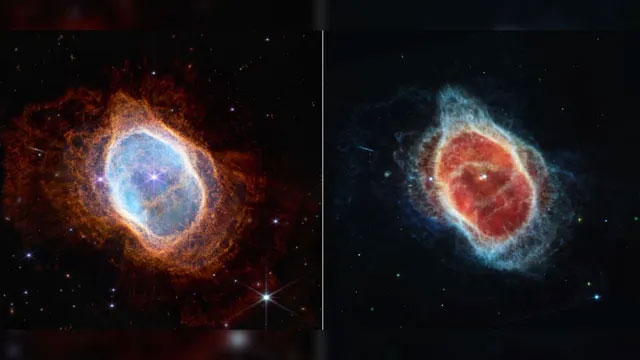
To capture colorful images of nebulae, telescopes—such as the Hubble Space Telescope and the James Webb Space Telescope (JWST)—use the infrared radiation emitted by the nebulae themselves to record images.
Visible light emitted by stars forming in and around nebulae can be blocked by the dense clouds of gas and cosmic dust that make up the nebula. Therefore, scientists must search for other wavelengths of light emitted from nebulae, such as infrared radiation.
Using the Near-Infrared Camera (NIRCam) and the Mid-Infrared Instrument (MIRI), JWST captured some of the most detailed images of the nebula. In the two images above, JWST captured the layers of gas and dust inside the Southern Ring Nebula. Each layer was created by the expulsion of cosmic matter from the dying star at its center.
- Scientists are abuzz over the James Webb telescope's image of a purple galaxy.
- China is using nuclear power to carry out its mission to Neptune.
- NASA's most powerful rocket in history is about to fire: What world records will it pave the way for?