Scientists have found a new limit on the mass of a particle of light (photon) based on indirect measurements.
Light particles (or photons) are inherently described as massless particles. This is because they move through space-time at a constant speed, and cannot speed up or slow down in a vacuum.
The constant velocity of photons means that they have no mass, and there is no evidence to contradict this.
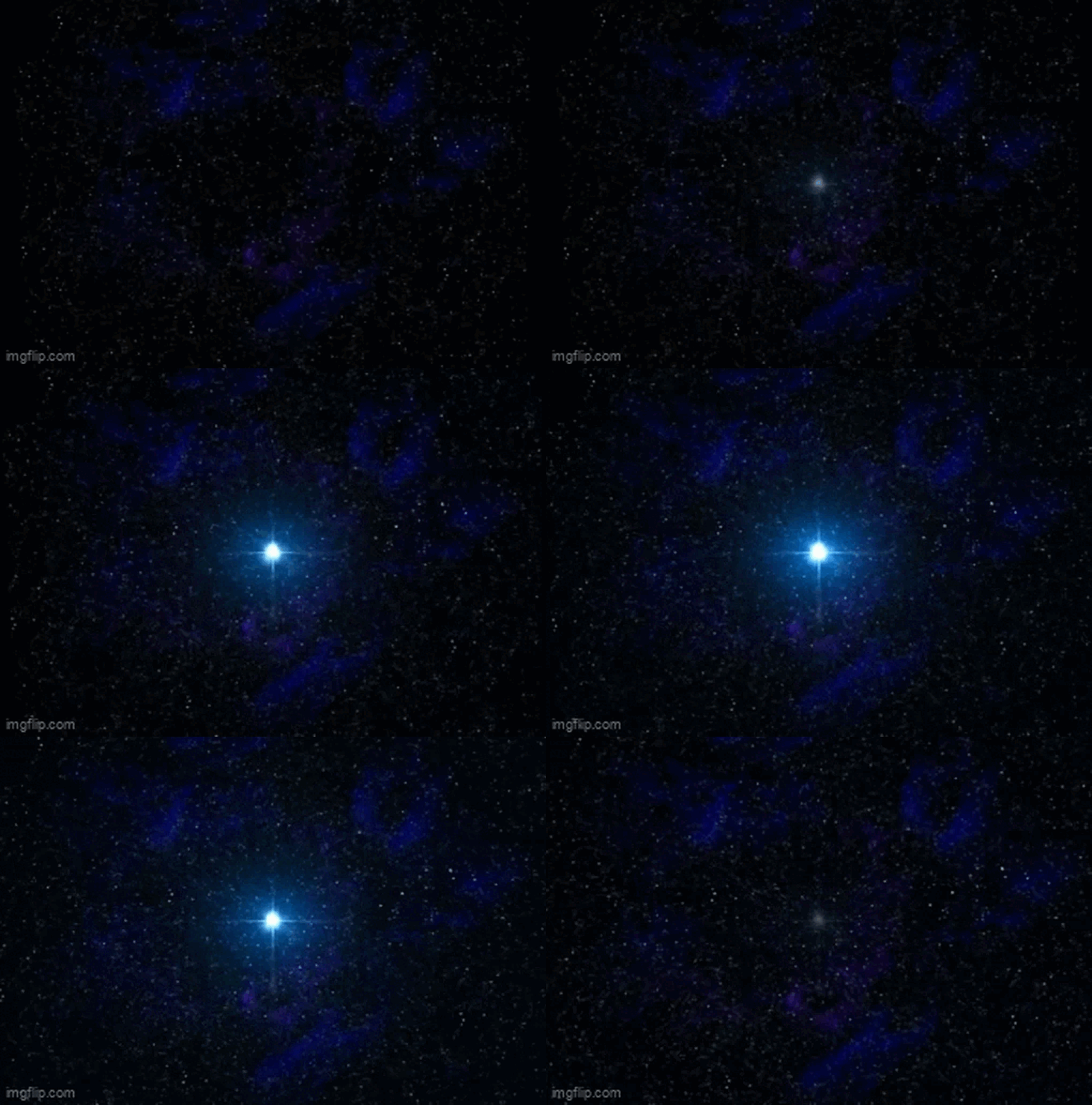
Image of a pulsar twinkling in the distance (Photo: NASA).
However, now a research team from Sichuan University of Science and Technology, Chinese Academy of Sciences and Nanjing University, has shown the opposite.
It is the photons that have mass , and we can actually "count" them based on indirect measurements.
By studying data from fast radio bursts (extremely powerful bursts of light of unknown origin detected across vast regions of intergalactic space), the team found a delay time that was proportional to the mass of the photon.
From the ratio calculations, they were able to deduce the upper limit of the photon to be 9.52 x 10-46 kg (an energy equivalent to 5.34 x 10⁻¹⁰ electron volt c-2).
"This is the first time that the interaction between photon masses returns a non-zero result in a plasma environment," the team emphasized.
Although this is a very small limit, discovering that light has any mass would have a significant impact on how we explain the universe around us, as well as our underlying understanding of physics.
This would also contradict Einstein's special theory of relativity and Maxwell's theory of electromagnetism, leading to a new foundation of physics, or even answering some of the big unanswered questions about the universe.
The study also demonstrates the need for highly accurate radio telescopes to obtain quality and consistent data, astronomers say.
They believe that with the advancement of technology, humanity will narrow down the measurements even further, as well as find out the potential effects of light particles on the universe around us.