A timeless treasure that surpasses all previous records has been unearthed by Canadian scientists in James Webb's astonishing archive: A near-missed light fossil .
It is a "cross-dimensional" light that is not of reality, but existed 9 billion years ago , and may have disappeared today. However, James Webb captured it from a world 9 billion light years away, because it takes that long for light to reach Earth.
According to Space, that is Sparkler, the galaxy containing the most distant globular clusters ever recorded , which a research team from institutes and schools at the University of Toronto - Canada identified through analyzing unique data from the James Webb space telescope of NASA/ESA/CSA (space agencies of the US, Europe and Canada).
These clusters likely contained the universe's first stars, according to astronomer Lamiya Mowla, co-author.
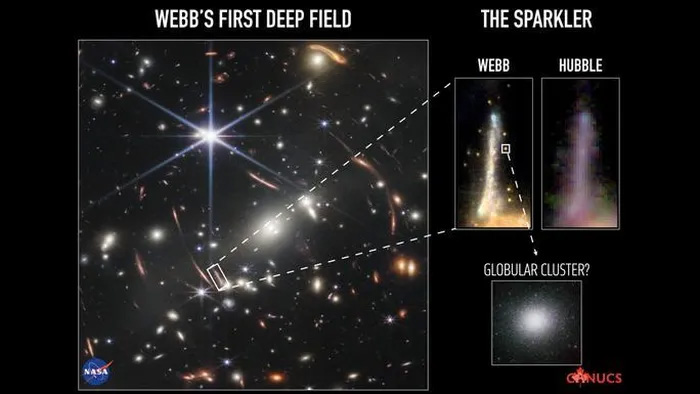
This image from James Webb reveals the Sparkler Galaxy contains the oldest globular clusters, which may have contained the universe's first stars - (Image: NASA/ESA/CSA)
Sparkler, which contains globular clusters dubbed "light fossils," appeared so clearly in the James Webb data that scientists were able to observe its sparkles across a range of wavelengths, modeling them and understanding their physical properties, according to Science Alert .
This is of great significance to astronomy because globular clusters are ancient objects that appear near the centers of galaxies as a kind of satellite, containing stars much older than scattered clusters, many of which are even approximately as old as the universe.
Globular clusters are what will tell us about the early universe and when the first stars formed.
A globular cluster observed from a world 9 billion years ago would provide a unique "window in time" to look at it when it was still relatively "young", thereby understanding what the "youth" of these old stars was like, or more ambitiously, where they came from and how they were born.
According to astrophysicist Karrtheik Iyer, co-author, they closely studied 12 globular clusters in Spakler and found that five of them did not have the amount of oxygen expected for an active phase of star formation.
These must be the oldest globular clusters, which no longer form new stars, a kind of static fossil.
The above information is only the most preliminary results. Scientists will continue to carefully analyze this rare light fossil.
The study was recently published in the scientific journal The Astrophysical Journal Letters.