Scientists are trying to decode an ancient flower to understand why its seeds can "sleep" for tens of thousands of years.
Several years ago, Russian explorers found a
32,000-year-old cache of seeds of a flower called Silene stenophylla buried 20-40m below the permafrost in a squirrel burrow near the banks of the Kolyma River in Siberia. Around the excavation site were also found many bones of mammoths, bison and Ice Age rhinos.
Many mature seeds were damaged by squirrel gnawing but some immature seeds retained viable tissue.
The team then extracted tissue from the immature seeds, placed them in test tubes, and successfully germinated the plants. The regenerated plants were identical but slightly different in shape from the modern Silene stenophylla. They were larger, flowered, and produced new seeds in less than a year.
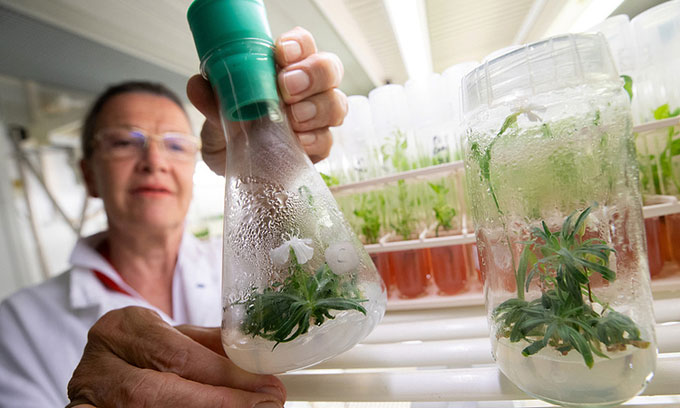
A tree grown from a 32,000-year-old seed bloomed in the laboratory on June 30. (Photo: CGTN).
New research shows that the Ice Age permafrost is actually a great genetic repository where any extinct plant species could be found and revived.
These are believed to be the oldest buried plant seeds ever found. The results mark a major step forward in the study of ancient biological material and offer hope for the recovery of lost plant species.
The team from the Russian Academy of Sciences then extracted ovule tissues from the frozen seeds and cultured them with a mixture of different nutrients. Under controlled temperature and light conditions, the tissues germinated, took root, and developed into plants inside a greenhouse environment.
At the University of Natural and Life Sciences Vienna in Austria, Professor Margit Laimer and her colleagues are working to sequence the ancient plant's genome and decipher its DNA. They want to find out what's special about its genome and how its components work together. The ultimate goal is to find the conditions that allow seeds to remain dormant for tens of thousands of years.
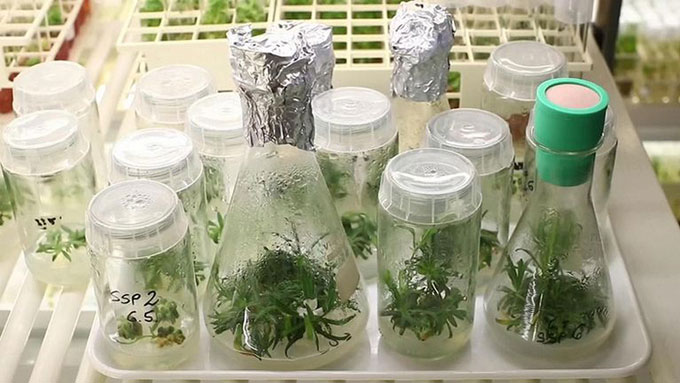
Austrian scientists are trying to decode the genome of Silene stenophylla. (Photo: CGTN).
"Plants also change and adapt to their environment. We hope to find changes in their genes that help plants adapt to very dry, very cold, or very hot conditions. Using this knowledge, we can find ways to improve plant varieties ," Laimer said.
Scientists are keen to understand whether changes in plant genes that can adapt to very dry, hot or cold conditions could be useful in tackling climate change, says Professor Margit Laimer.
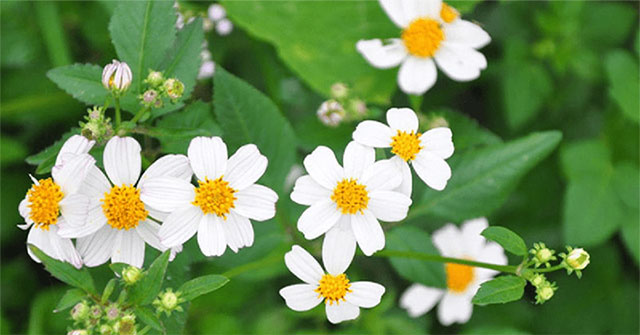
Silene stenophylla is classified in the Carnation family . This white-flowered plant grows in the Arctic tundra and the mountains of northern Japan. It is only 5 to 15 cm tall, with narrow leaves and large calyxes.