Dogs' ability to find their way home may have been inherited from their ancestors , the gray wolf. Wolves roamed vast swaths of land across Eurasia.
In 2015, Georgia May, a rescue dog, walked 35 miles (56km) home after getting lost during a hike in San Diego, California.
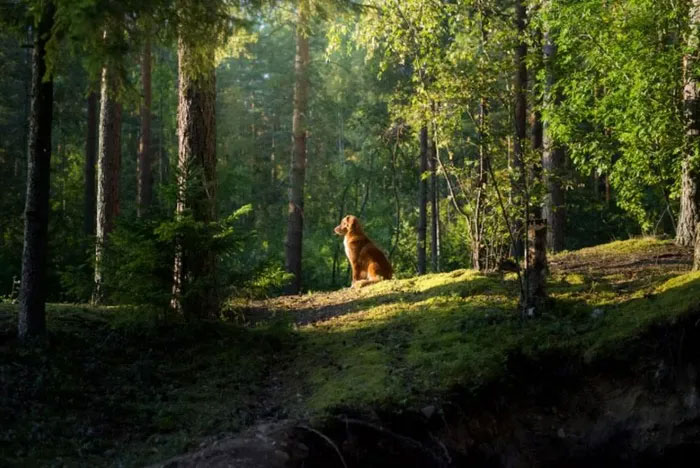
(Illustration: National Geographic).
Laser, the beagle, returned to his Winnipeg, Manitoba, neighborhood in 2010, six weeks after being separated from his family during a fireworks display 50 miles (80km) away.
Back in 1924, Bobbie, a border collie who got separated from his family on a road trip, found his way home to Silverton, Oregon. The dog traveled 2,800 miles (4,506km) from Indiana over six months and through several mountain ranges.
How do dogs do such 'extraordinary' things ? - Experts say it's because they possess homing instincts and keen senses.
'Mind Map'
According to National Geographic, dogs' ability to find their way home may have been inherited from their ancestors, the gray wolf . Wolves roamed vast swaths of land across Eurasia, where dogs were first domesticated.
Like humans , "dogs seem to be able to build mental maps [literally: visual representations in their minds] of their environment," says Zazie Todd, author of 'Bark! The Science of Helping Your Anxious, Fearful, or Reactive Dog,'
"It's possible that a dog's 'mental map' of its environment is slightly different from ours, as it may be driven by scent."
Tracking, or following a scent trail , is how dogs navigate their environment. Dogs have a sense of smell that is 10,000-100,000 times stronger than ours, giving them the ability to sniff out everything from explosives to COVID-19 to diabetes.
Dogs can also recognize familiar places by sight, smell, and sound.
Bridget Schoville, senior director of behavioral science at the American Society for the Prevention of Cruelty to Animals (ASPCA), says some dogs can navigate by recognizing the relative location of a familiar landmark to their home, and their current location relative to that landmark.
'From those waypoints, they can follow a fairly straight path home.'
Calibrating the 'biological compass'
Migratory birds, salmon and whales are just a few animals that can 'tune in' to the Earth's magnetic field. Dogs may also possess this mysterious ability.
In a study published in 2020, researchers in the Czech Republic 'recruited' 27 hunting dogs to participate in a three-year experiment.
In more than 600 field trials, scientists attached global positioning system (GPS) trackers and cameras to dogs before releasing them into an unfamiliar forest.
They then tracked the dogs as their owners called them back home. All the dogs in the study ran an average of nearly a mile (1.6km) into the woods.
More than half (60%) of the dogs in the study used their sense of smell to retrace their steps and find their way back to their handler.
But the other 30% of the dogs did something else: They used a scouting strategy – following a new route that started by running a short distance along the north-south axis of the forest, regardless of where their trainer was.
Without any familiar visual cues to use, the dogs in the study were able to orient themselves using the Earth's magnetic field.

(Illustration: National Geographic).
The researchers called this 'strategy' "compass-following". In this way, the dogs found their owners much faster than dogs that just sniffed their owners' scent. The authors concluded that dogs may combine their 'mental map' with the magnetic field to navigate when lost.
"We have not yet found any convincing evidence that dogs use magnetic signals for navigation, but this is the most plausible explanation," said study co-author Hynek Burda, professor emeritus of zoology at the University of Duisberg-Essen in Germany.
Dogs can also combine these sensory methods. While sniffing is slower than scouting, it can be safer in some situations.
"Sticking with people"
Burda said it was possible to switch between different 'strategies' , but overall, 'most dogs don't have the ability to learn, gain experience, and come home from distant and unfamiliar places'.
As modern dog breeds are bred to be close to their owners, 'amazing' trips like the examples above are becoming less common.
Dogs raised with humans can form bonds with humans similar to the bond between a parent and child, says Monique Udell, director of the Human-Animal Interaction Laboratory at Oregon State University.
And an important aspect of this bond is the strong motivation to seek reunion when separated."
'When a dog goes missing, it's a terrifying experience for them, so it's important to keep your dog from wandering off in the first place,' Todd added.
You can get your dog a microchip or collar with your phone number. "This is the most helpful thing we can do to make sure the dog doesn't have to find its way home," says Todd.