Humans need oxygen to breathe. If there isn't enough oxygen anywhere in the Solar System, death comes quickly. The only difference between planets is whether their temperature or pressure kills us quickly or not.
" Earth's atmosphere today is 20 percent oxygen . Without oxygen, humans would die of asphyxiation in about seven minutes ," Jennifer Glass, an associate professor in the School of Earth and Atmospheric Sciences & Biological Sciences at the Georgia Institute of Technology, told Newsweek .
Here's what would happen to humans on each planet, starting with the planet closest to the Sun.
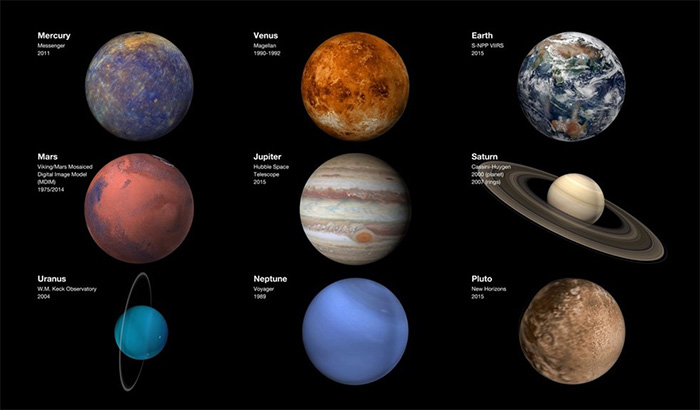
Different planets cause different causes of death - (Photo: NASA).
Mercury
The fact that Mercury is the closest planet to the Sun indicates that it is not a hospitable planet.
On the side of Mercury facing the Sun, temperatures rise to 426⁰C. Meanwhile, at night, temperatures plummet to -142⁰C.
So death on the cold side would be similar to death in space and could be over in minutes. 'If you were on the hot side, you would burn to death in seconds, and all the water would evaporate from your body ,' says Glass.
Venus
Venus' thick atmosphere creates a greenhouse effect that raises its surface temperature to around 464⁰C. According to NASA, the thick atmosphere also means that the pressure on the surface would be lethal. Unfortunately, it also has clouds of sulfuric acid.
'While struggling to breathe, a person would be burned by the extreme heat and acid within seconds. At least it would be a quick death , but also a horrible death,' according to Ms. Glass.
Mars
Mars may offer the best chance of survival of any place in the Solar System, except Earth.
The planet has temperatures that reach a balmy 21⁰C in summer, although they drop to -107⁰C at the poles.
However, even if a person were placed on the equator in the summer, they would not survive long. Mars' atmosphere is almost pure carbon dioxide (CO 2 ). This would make it one of the worst planets to die on .
"If carbon dioxide builds up in the blood of a person who is suffocating, they will experience intense shortness of breath before losing consciousness and then dying of asphyxiation. If their blood is diluted by breathing a gas that does not contain carbon dioxide, such as hydrogen, helium, nitrogen, methane, etc., the person will lose consciousness within seconds, without feeling short of breath. So death will be less painful, but they will still die within minutes from lack of oxygen ," Ms Glass said.
Jupiter, Saturn, Uranus and Neptune
The gas giants in the Solar System are grouped together because the death process is basically the same , but can also vary depending on which planet you come from since they don't have surfaces.
Being placed in the center of a giant mass of gas means instant death can occur, without even feeling it.
For example, Saturn's core is around 9,444⁰C and the pressure at Jupiter's core is so high that it's like having 160,000 cars stacked on top of each other across your body.
Temperatures range from -74⁰C on Jupiter to -165⁰C on Neptune.
"There's no solid ground on the gas giants, so you just fall through them until you're crushed under their intense pressure. Their atmospheres are hydrogen with some helium, methane and water, carbon dioxide, so at least when you freeze and get crushed to death, you'll pass out more gently, without the panic of increased CO2 due to high carbon dioxide levels like on Venus and Mars ," Ms Glass stressed.