The James Webb Telescope has opened a new era of scientific breakthroughs, providing images of distant regions of the universe, helping humans look back in time.
Related reading: James Webb Telescope Reveals Secrets of the Universe: Was the Big Bang Just a Man's Imagination?.
On May 30, the US National Aeronautics and Space Administration (NASA) announced that the James Webb Space Telescope had just discovered a galaxy believed to be the most distant galaxy ever observed .
This galaxy is a remarkable bright star system that existed just 290 million years after the Big Bang.
Launched in July 2022, the James Webb Space Telescope is the most powerful space telescope ever built. It has ushered in a new era of scientific breakthroughs, providing images of distant parts of the universe and allowing humans to look back in time.
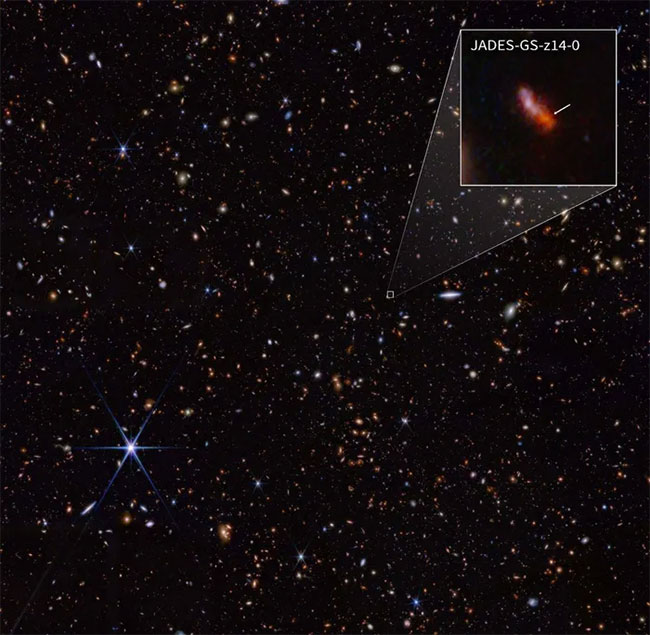
The JADES-GS-z14-0 observations overturned astronomical predictions about the earliest galaxies that formed after the Big Bang 13.8 billion years ago. (Source: webbtelescope).
Researchers stress that James Webb's latest discovery has profound implications for understanding the dawn of the universe.
In a joint statement, the international team of astronomers said they first discovered the galaxy, called JADES-GS-z14-0, in early 2023.
However, they need more observations to make sure that this galaxy is indeed the most distant galaxy observed to date.
'The source is so incredibly bright, so unexpected for such a distant galaxy and so close to another galaxy, that both appear to be part of a larger object,' said Stefano Carniani of the Scuola Normale Superiore in Italy and Kevin Hainline of the University of Arizona.
Before light from the most distant galaxies reaches Earth, the light is stretched by the expansion of the universe and shifts into the infrared region of the light spectrum, which the James Webb Telescope is equipped to detect with unprecedented clarity.
In October 2023 and January 2024, the team conducted observations to confirm their hypothesis, using James Webb's primary imager, called NIRCam, and the NIRSpec instrument, respectively, to analyze the light spectrum from an object and determine its physical properties.
JADES-GS-z14-0 breaks the previous record for the oldest known galaxy, JADES-GS-z13-0, which existed 320 million years after the Big Bang.
After determining the age of the galaxy JADES-GS-z14-0 in January this year, Mr. Hainline expressed great surprise. This researcher compared: 'If the universe were a 2-hour movie, this galaxy would appear in the first 2 and a half minutes.'
Based on the images, the galaxy JADES-GS-z14-0 is located 1,600 light years from Earth. According to the researchers, the light from the stars shows that this galaxy is hundreds of millions of times more massive than the Sun. The scientists wonder how nature could have created such a bright and massive galaxy in less than 300 million years.
Further analysis of the light emission revealed the presence of oxygen, another surprising finding that suggests that many generations of very large and massive stars existed before the galaxy was observed.
Thus, the JADES-GS-z14-0 observations overturn astronomical predictions about the earliest galaxies formed after the Big Bang 13.8 billion years ago.
Researchers say they have only observed a relatively small portion of the night sky, so it is likely that more bright and earlier-forming galaxies will be discovered in the coming years.