Strange data from a NASA spacecraft reveals the ghostly, wrinkled, rippled structure of the cosmic "bubble" that surrounds the Solar System .
According to Science Alert, both of NASA's Voyager probes, now flying out of the Sun's control, have just provided strange data about the interface between Earth's host world and the so-called "interstellar space".
They revealed to Earthlings that we are surrounded by an invisible, gigantic, inexplicable bubble-like structure, within which the so-called "heliosphere" is encapsulated.
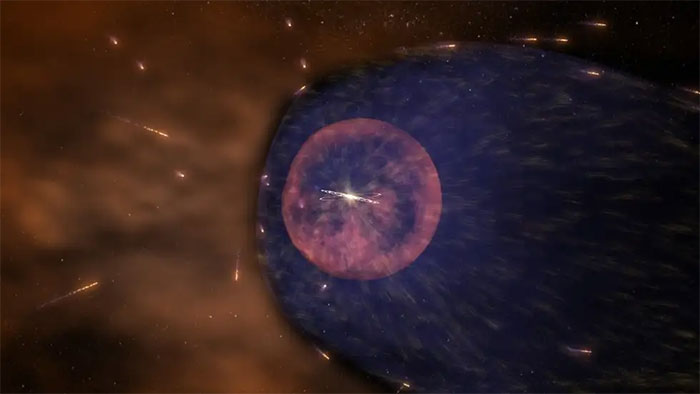
The turbulent region with constant confrontation between the solar wind and high-energy interstellar wind - (Graphic image from NASA)
However, another spacecraft called NASA's IBEX, which orbits only Earth but has the ability to measure through space, has just given us the first look at the surface of the mysterious bubble.
IBEX measures neutral atoms energized when the solar wind collides with interstellar winds at the boundary of the Solar System. Some atoms are launched farther into space while others are thrown back toward Earth.
The number of atoms thrown back has revealed a view of the strange bubble - the eternal boundary where the solar wind and interstellar wind confront each other: The surface of the giant bubble is intricately rippled, strangely wrinkled, shown in a 3D model created by a team of scientists led by astrophysicist Eric Zinstein from Princeton University - USA.

The strange, wrinkled, and wavy surfaces of the bubble that surrounds the heliosphere - (Photo: NASA)
Those 'wrinkles' are actually tens of astronomical units in size. One astronomical unit (AU) is the distance from the Sun to Earth.
The team also modeled the data to simulate how high-pressure winds from interstellar space would impact the heliosphere. These are all violent impacts, but thankfully, because they are so far away, they have little impact on us.