Before man first set foot on the Moon, Johannes Hevelius published a detailed lunar atlas down to every crater .
Before man first set foot on the Moon, Johannes Hevelius (1611 - 1687) published a detailed map of the Moon down to every crater. Using only a homemade observatory, he discovered and left behind a treasure trove of knowledge that will forever be admired by posterity.
Passion for astronomy
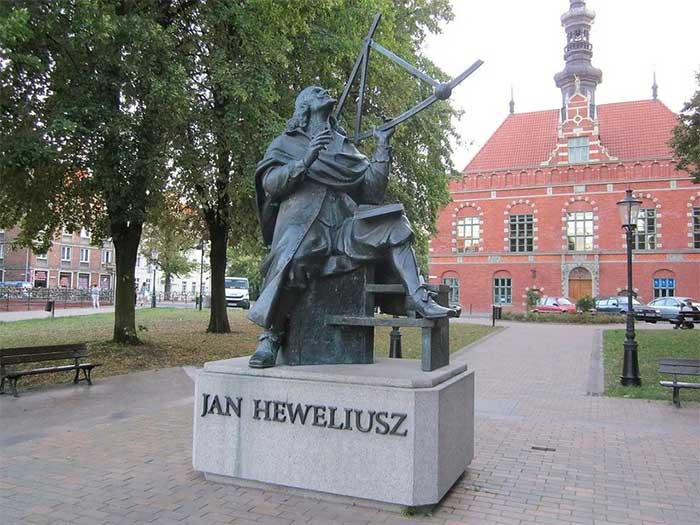
Astronomer Johannes Hevelius in Gdańsk, Poland. (Photo: Smithsonianmag.com).
Hevelius was born in Danzig, Kingdom of Poland (today the port city of Gdańsk). The Hevelius family was a brewer, so his father expected his son to grow up to be a merchant, and when he had a strong economic foundation, to enter politics and eventually become mayor.
Following his father's wishes, Hevelius studied hard, ready to become a good manager of the family business. In 1635, at the age of 24, he married a rich neighbor, Katharine Rebeschke. In 1636, Hevelius joined the brewers' guild, and by 1643 he had become its head. From 1651 until his death, Hevelius was a member of the town council.
However, Hevelius's favorite work was never business or politics. Ever since his school days, when a teacher named Peter Krüger introduced him to astronomy, Hevelius had longed to devote his entire life to the study of the stars.
To satisfy his desire to explore astronomy, in 1641, Hevelius invested almost all of his income from his family's brewing company into building an observatory on the roofs of three adjacent houses he owned in Danzig.
Hevelius personally designed the complex observation instruments, named his observatory 'The Castle of the Stars' and turned it into one of the greatest astronomical observatories in Europe during this time. The fame of 'The Castle of the Stars' was so great that even the astronomer who accurately predicted the return of the comet - Edmond Halley (1656 - 1742 ) traveled hundreds of miles to find it.
In Hevelius' time, tides were of great concern. Not only in Poland, but also in many other coastal countries, people believed that the Moon was the agent of tides and understood that the Moon was the shortest way to find a method of measuring longitude at sea.
From the beginning, Hevelius' astronomical goal was to map the Moon. After many nights of watching the Moon through a giant telescope he had made, Hevelius made some preliminary sketches and engravings. In Paris, the paradise of astronomical research in France, Hevelius had a friend and fellow countryman who was also interested in mapping the Moon, Peter Gassendi (1592 - 1655). Hevelius sent his first sketches to Gassendi, who enthusiastically encouraged him to continue.
'Heaven has endowed you with eyes so extraordinary that they are called lynx eyes ,' Gassendi wrote in a letter back to Hevelius. This compliment made Hevelius so happy that he continued to stay up all night to observe the Moon and in the morning, he engraved what he saw. Finally, after 5 years, Hevelius completed the project of mapping the Moon, publishing Selenography , or A Description of The Moon, which amazed the whole world.

A page from Hevelius's lunar atlas. (Photo: Smithsonianmag.com)
Map of the Moon
Before Hevelius, two astronomers had drawn maps of the Moon: Thomas Harriot (1560 – 1621, England) and Galileo Galilei (1564 – 1642, Italy). However, their maps were very sketchy. In contrast, Hevelius's 'Selenography, or Lunar Map' is extremely detailed and aesthetically pleasing. It consists of about 40 drawings, each depicting the Moon at a different stage of its cycle.
Hevelius drew an almost exact drawing of the Moon's surface, complete with craters, slopes, valleys, and varying degrees of darkness throughout the day. Anyone knowledgeable about the Moon could tell which day it depicted by looking at his drawing. Hevelius also observed Saturn, Mars, and Jupiter - the three planets he believed to be 'fixed stars' - and depicted them all on his drawing.
Each page in the 'Selenography, or Lunar Map' is a double-page spread, with the Moon occupying both pages. All the features were named by Hevelius and, being so numerous, were so confusing that they were not accepted by astronomers.
'Hevelius' system of naming lunar features was so complex, because he classified them based on comparison with Earth. So they ranged from continents to islands, bays, rocks, lagoons…' , later astronomers explained.
However, the accuracy and aesthetics of the 'Selenography, or Lunar Atlas' were beyond reproach. For the next century, it remained the most reliable lunar atlas.
After 'Selenography, or Lunar Map' , Hevelius also devoted himself to cataloguing more than 1,500 stars with clear positions and distances. This time, he did not work alone but had the contribution of Elisabeth Koopman, his second wife, 35 years his junior.
It was Elisabeth 's passion for astronomy that led her to Hevelius. Unfortunately, on September 26, 1679, while the couple was away, the 'Starry Castle' caught fire. From the observatory to the notes and stacks of manuscripts, everything was burned to ashes.
Fortunately for Hevelius, his daughter had taken the catalogue of more than 1,500 stars and stored them elsewhere. Through the Siege of Danzig in 1734, and even the bomb-filled Second World War, the catalogue survived, and in 1971, like a phoenix rising from the flames , it suddenly appeared at Brigham Young University.
Today, with the most advanced measurement technology, mankind has even 3D maps of the Moon, the universe. and of course, we can also confirm the distances between stars almost accurately. Interestingly, even with just the naked eye and homemade astronomical instruments, Hevelius also estimated the distances not too different from the current data .