Crab-like bodies are so evolutionarily advantageous that they have evolved at least five different times.
Our planet's complex evolutionary history has produced countless weird and wonderful creatures, but none have sparked as much curiosity among evolutionary biologists—or divided taxonomists—as the crab.
When researchers attempted to analyze the evolutionary history of the crab in a study published in 2021, they concluded that the defining characteristics of crab-like body structures have evolved at least five separate times among decapod crustaceans over the past 250 million years.
This repeated evolution of a crab-like body plan occurs so frequently that it has its own name: carcinization .
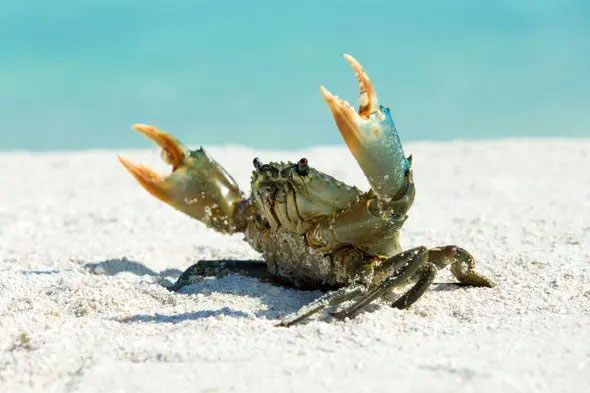
The defining characteristics and body structure of crabs have evolved at least five times.
Carcinization is an example of a phenomenon called convergent evolution , which is when different groups of organisms independently evolve similar traits. That's why bats and birds both have wings. But interestingly, the evolution of crab-like bodies has occurred repeatedly among very closely related animals.
Why evolution continues to engineer and adapt the bodies of many creatures to resemble crabs remains a mystery , but we do know that there are thousands of species of crabs that thrive in almost every habitat on Earth, from coral reefs and abyssal plains to creeks, caves, and forests.
Crabs also vary greatly in body size, with the smallest species being the pea crab (Pinnothera faba), measuring just a few millimeters, while the largest, the Japanese spider crab (Macrocheira kaempferi), is nearly 4 meters long when measured between the claws.
With their species richness, body shape diversity, and rich fossil record, crabs are an ideal group of organisms for studying biodiversity trends over time .
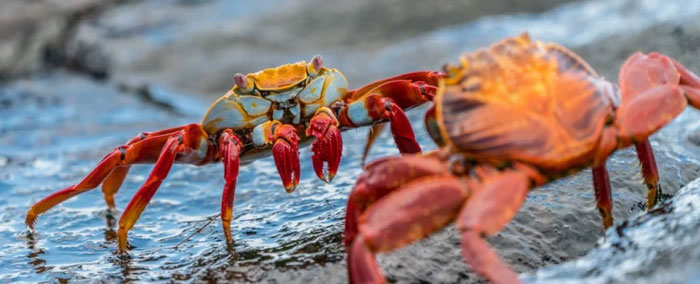
Crabs are also a very diverse species in terms of body size.
Crustaceans have repeatedly shifted from a cylindrical body shape with a large tail - characteristic of shrimp or lobsters - to a flatter, rounder, more crab-like shape with a tail tucked under the belly.
As a result, many crustaceans have evolved to look very much like crabs, such as the king crab, which has a crab-like body structure, but actually belongs to a closely related group of crustaceans called "false crabs".
The most obvious difference between "true crabs" and "false crabs" is the number of walking legs they have: true crabs have four pairs of legs, while false crabs have only three.
Both true and false crabs evolved broad, flat, hard upper shells and drooping tails independently, from a common ancestor that lacked those traits, according to an analysis published in March 2021, led by Harvard University evolutionary biologist Joanna Wolfe.
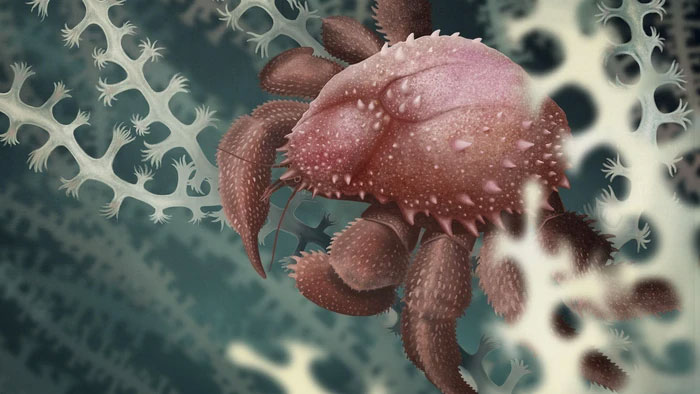
Many crustaceans have evolved to look very much like crabs.
As with many topics, evolutionary biologists have many ideas to explain this, but at present there is no definitive answer to the question of carcinization.
When a trait appears in an animal and persists through generations, it's a sign that the trait is beneficial to the species. That's the basic principle of natural selection. Crab-like animals come in a wide range of sizes and thrive in a wide range of habitats, from mountains to the deep sea. Their diversity makes it difficult to pinpoint a single overall benefit to their body structure, says Joanna Wolfe.
Wolfe and colleagues offered several possibilities in a 2021 paper in the journal BioEssays. For example, the crab's retracted tail, compared to a lobster's, might reduce the amount of vulnerable flesh accessible to predators. And the round, flat shell might help the crab flip sideways more efficiently than a lobster's cylindrical body.
But more research is needed to test those hypotheses, Wolfe says. She's also trying to use genetic data to better understand the relationships between different species of decapod crustaceans, to pinpoint more precisely when different 'crab' lineages evolved, and to tease apart the factors that drive carcinization.
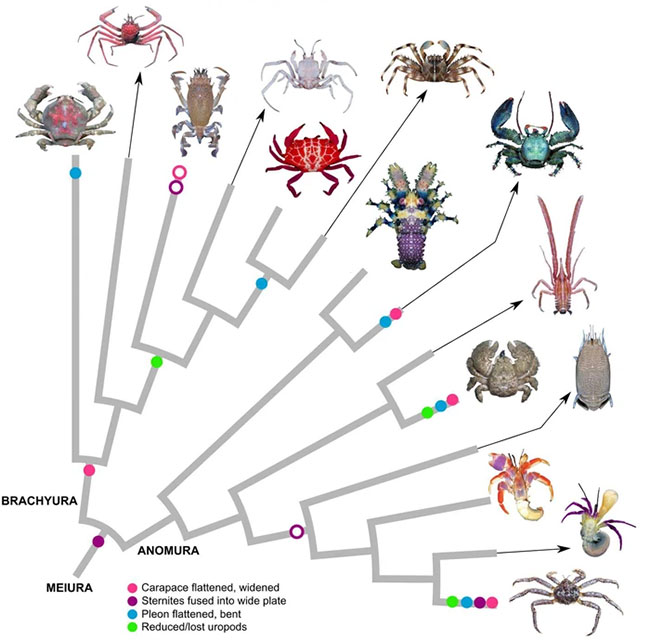
The crab's body shape may have given the animal the flexibility to develop specialized roles for its legs beyond walking, allowing the crab to adapt easily to new habitats. Some crab species have adapted their legs to burrow under sediment or paddle through water.
Most species that have undergone carcinization develop hard, calcified shells to protect them from predators—an obvious advantage—but some crabs have subsequently abandoned this protection for unknown reasons.
Sideways walking, while seemingly silly, means that the crab is extremely agile, able to escape quickly in either direction without losing sight of predators, should they appear. But sideways walking is not observed in all crab lineages that undergo carcinization (there are species of spider crabs that walk forward), and some hermit crabs that do not undergo carcinization can also walk sideways.