Spanning 2,820 km, the network of pipelines and channels belonging to the Giant River project is often described as the world's largest underground water system.
North Africa, known for its vast deserts and scarce water resources, undertook one of the most ambitious water supply projects more than half a century ago. The massive Artificial River project remains essential for millions despite numerous challenges in recent years. The project's origins date back to 1953 when Libya experienced an oil boom. While searching for oil, geologists discovered underground aquifers containing ancient water, some dating back 38,000 years. These reservoirs hidden deep beneath the Sahara Desert offer a potential solution to Libya's chronic water scarcity, according to Interesting Engineering .
However, the project didn't begin until 1969. With Colonel Muammar Gaddafi's rise to power, the idea of exploiting the aquifer attracted attention. Gaddafi recognized the potential for transforming Libya's arid environment and proposed the Giant Artificial River project with the goal of "making the desert bloom."
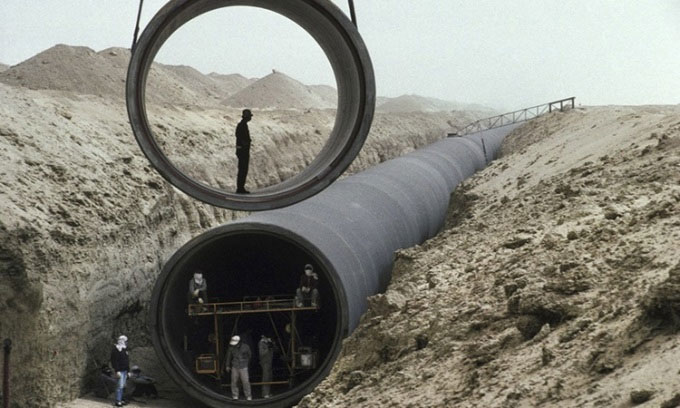
Water pipes used in the Giant River project. (Photo: Middle East Institute).
Project scale
The aquifer network connects the southern region with major population centers along the Mediterranean coast, including Tripoli and Benghazi. In terms of natural resources, the site resembles a potable oil deposit.
Ancient water bodies in Libya are primarily located in four large basins. The largest of these is the Kufra basin near Egypt, spanning 350,000 km² . Its aquifer covers an area of 200,000 km² and is 2,000 m deep. In the Sirte basin, the aquifer, 600 m deep, contains approximately 10,000 km² of water-bearing rock . The Murzuk basin covers 450,000 km² , with about 4,800 km² of water-bearing rock.
Water sources were also found in the Hamadah and Kufrah basins, extending from the Qargaf Arch and Jabal Sawda areas to Libya's Mediterranean coast. Construction began in 1984, marking the start of a multi-phase project spanning decades. The first success came in 1989 when water flowed into the Ajdabiya reservoir.
Multi-phase project
The initial phase, called Phase 1, involved excavating 85 million cubic meters of earth and installing large pipelines to transport water from the As-Safir and Tazerbo regions to Ajdabiya, Benghazi, and Sirte. Phase 2 will pump water from the southwestern aquifer (Fezzan) to Tripoli and the Jeffara plain. Phase 3 of the project aims to strengthen the existing infrastructure from Phase 1. This expansion phase will increase the daily water supply by 1.68 million cubic meters, bringing the total capacity to 3.68 million cubic meters.
The plan included the construction of eight additional stations and the installation of 700 km of new pipelines. Phase 3 was also designed to supply 138,000 m³ of water daily to the Tobruk and coastal areas. While the project was underway, its impact on life in Libya became clear. By the late 1990s and early 2000s, cities that had struggled with water shortages saw significant improvements. The massive artificial river project provided water for agriculture, industry, and domestic use throughout the country.
Technical and political challenges
The project faced numerous challenges. From its inception, it encountered many technical obstacles due to its large scale. The need to dig deep wells, construct large pipelines, and pump water over long distances in the harsh desert environment presented significant difficulties. Libya's political isolation under Gaddafi also hampered the project's development. Despite these obstacles, the Libyan government considered the project a matter of national urgency.
The impact of political conflict and neglect is becoming increasingly evident. In 2019, reports indicated that 101 of the 479 wells in the western pipeline had been dismantled. In 2020, the situation worsened when armed forces seized control of a water treatment plant supplying Tripoli. Despite this, the massive Man-Miracle River project remains crucial to Libya's water supply, meeting approximately 70% of the country's clean water needs. Its importance is particularly highlighted in a country lacking natural rivers and with scarce rainfall.
The future of the project
The future of the project remains uncertain. Due to ongoing instability, the completion of Phase 3, aimed at expanding the system to supply water to Tobruk and other coastal areas, has stalled. Phase 4, intended to fully implement the project, has yet to begin. Years of neglect have led to infrastructure deterioration, requiring extensive repairs and maintenance investment.
Security concerns continue to hinder maintenance efforts, deterring international companies from participating in the project. Furthermore, there are questions about the long-term sustainability of pumping water from a non-renewable aquifer. The project's future is tied to Libya's political stability and economic recovery. Completing the unfinished phases and ensuring the long-term viability of the infrastructure will require significant investment from the Libyan government and its people.