Data from the Cassini spacecraft shows NASA is on the right track in its hunt for alien life.
During its mission to observe Saturn and its moons that promise life, the Cassini spacecraft repeatedly captured streams of cold material from the moon Enceladus.
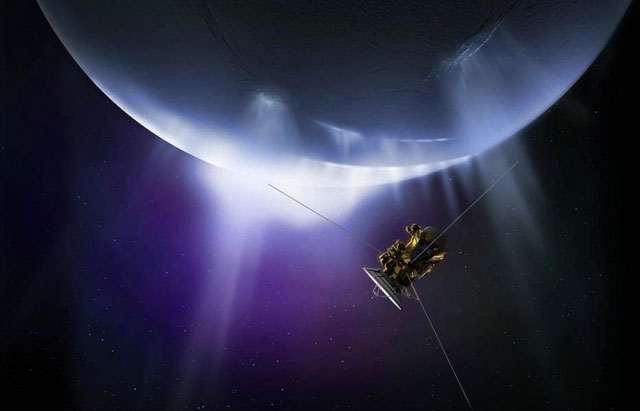
The stream of matter that the Cassini spacecraft was repeatedly hit by could be a "message" from aliens - (Photo: NASA)
Enceladus, named after a giant god in Greek mythology, is Saturn's sixth largest moon.
The plumes of gas, water vapor, and other materials erupting from beneath the moon's icy surface offer an opportunity to study the composition of the subsurface ocean.
Its value was further enhanced by a study just published in the Proceedings of the National Academy of Sciences, which demonstrated that these streams of material contain amino acids .
Amino acids are the basic building blocks of life that space scientists have always wanted to find.
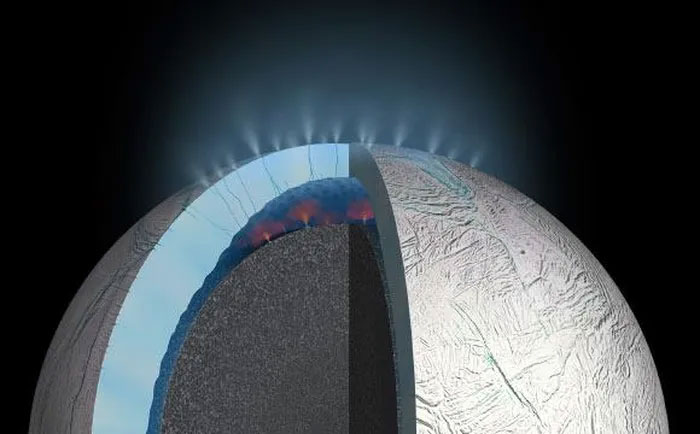
The interior of Enceladus, with its underground ocean possibly filled with alien life, is spewing icy jets of gas into space - (Photo: NASA).
In a study summary, Sci News reported that scientists from the University of California San Diego found evidence of amino acids by tweaking a spectrometer designed to study the collision dynamics of particles in aerosols.
They were therefore able to examine in detail the behavior of particles in the jet from Enceladus, looking for evidence of the presence of amino acids.
This new discovery is one of the clearest evidences of the existence of extraterrestrial beings, proving NASA's argument and belief.
Although Cassini ended its mission a few years ago by plunging into Saturn's atmosphere to avoid contaminating the "living moons" Enceladus and Titan, follow-up missions are in the works.
A robotic snake is being designed and tested by NASA scientists that could one day be 'dropped' onto Enceladus. The robotic snake is designed to traverse complex terrain, burrowing deep into ice channels to hunt for alien life.
Besides Enceladus, Saturn's moon Titan is also described by NASA as a "second Earth" , with special plans for the future.