A new approach by a Chinese research team has broken the cost barrier, while maintaining performance, for lithium batteries.
Why are solid-state batteries the future of electric vehicles?
Chinese scientists recently said they have successfully developed a solid-state lithium battery that can match other candidates for next-generation battery technology in performance, but costs 10% less.
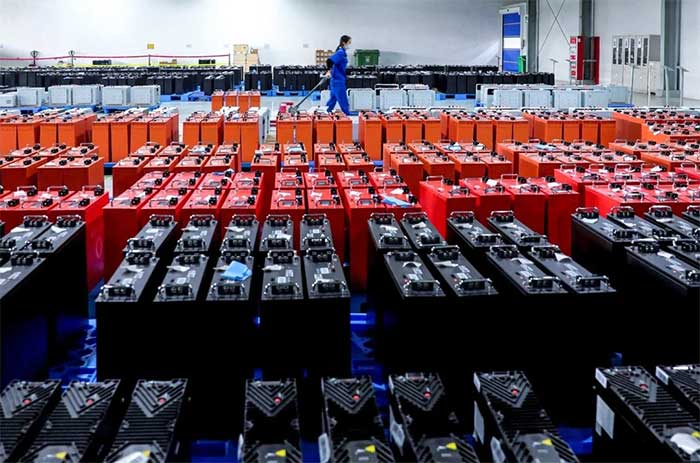
Major corporations around the world are racing to acquire rechargeable battery technology that will change the electric vehicle industry (Photo: AFP).
The move brings China one step closer to its ambition of becoming the first country to deliver what many see as the future of rechargeable battery technology , with the potential to revolutionize the electric vehicle industry.
It is known that although there have been significant advances, the size, weight and potential risk of explosion still make lithium rechargeable batteries unable to meet the requirements of the global electric vehicle industry in general.
Replacing the liquid electrolyte of conventional lithium batteries with a solid-state one could promise faster charging times, better performance and improved safety standards.
However, barriers from production costs, material rarity. create a global race to find a commercially viable solution.
Researchers from the University of Science and Technology of China (USTC) in Anhui Province, Southeast China, have developed a solid electrolyte that shows great promise for commercial applications.
According to a paper published June 30 by the German Chemical Society, one of the world's leading chemistry journals, the team took a new approach to a problem that has plagued scientists for more than a decade: cost.
Chinese scientists solve the difficult problem of lithium batteries

Chen Liquan, known as the "father of Chinese lithium batteries" . ( Photo: SCMP).
It is known that the "big guys" in the electronics industry, including Toyota (Japan) and Samsung (Korea), have invested significantly in research and development of suitable solid-state electrolytes, with three main groups of components, namely oxides, sulfides and chlorides.
According to Chen Liquan , who is known as the 'father of China's lithium batteries ,' to be commercially viable, solid-state battery electrolytes must cost less than $50 per kilogram to produce. This poses a major obstacle, as conventional sulfide electrolytes alone cost more than $195 per kilogram to produce.
To overcome this challenge, Ma Cheng - the leader of the research team from USTC - began developing a new sulfide solid electrolyte that he called LPSO . Its characteristic is that it does not require lithium sulfide as a raw material.
Accordingly, LPSO is synthesized from two low-cost compounds, with a component cost of only 14.42 USD/kg - less than 8% of the raw material cost of other sulfide solid electrolytes.
According to the researchers, reducing manufacturing costs does not take away from the unique advantages that current solid sulfide electrolytes can offer, including compatibility, performance stability, and safety in use.
In a real-world test, the LPSO used on an electric bicycle can maintain more than 4,200 hours of stable operation at room temperature.
Speaking to Science and Technology Daily, Ma Cheng said that LPSO is still expected to achieve further improvements in performance, and open up a new future for the electric vehicle industry.