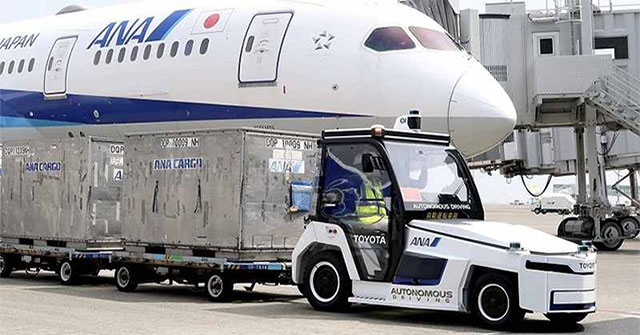
Starlink's ambition is to bring high-speed Internet access to every corner of the globe, a necessary application for many transportation giants and telecommunications carriers.

Starlink's satellite network can provide Internet coverage to every corner of the globe. (Photo: Getty).
Starlink is a satellite internet project by the space exploration company SpaceX, founded by Elon Musk. This service creates a network of thousands of satellites around the Earth, helping to provide high-speed internet from low orbit to remote, isolated areas on Earth.
Since its launch in October 2020, Starlink says it now has 400,000 subscribers across the 36 countries it operates in. Almost every major player in the transportation industry, including luxury cruise lines and airlines, wants to partner with the service.
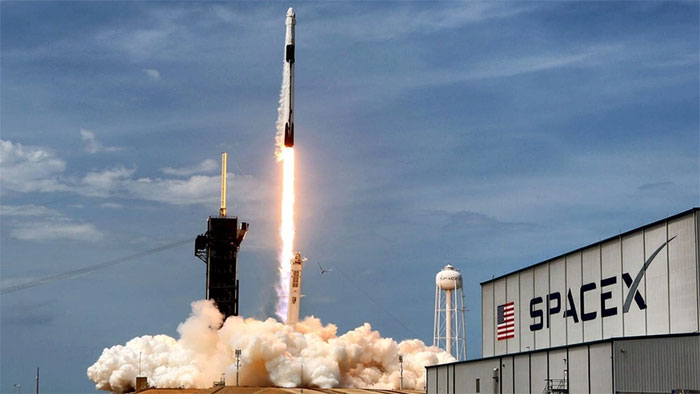
SpaceX's upcoming plan is to launch 42,000 satellites into orbit using the Falcon 9 rocket. (Photo: Getty Images).
If Starlink can realize its ambitions, the service could beam data directly to mobile phones, helping to eliminate blackouts around the globe.
The advantages that help Starlink lead the way in satellite Internet
Satellite Internet is a useful solution for places where conventional Internet systems are inaccessible, such as in mountainous or remote areas. However, limitations to satellite Internet development include national policies, economic and social barriers that contribute to the ability of many people to access the Internet.
Starlink breaks these barriers thanks to the launch pad from the space exploration company SpaceX. So far, the company of the richest billionaire on the planet has launched thousands of satellites into orbit. Because the satellites are launched in low orbit around the Earth, Starlink always provides the fastest possible connection speed between the satellite and the ground.
Since 2018, Starlink has launched about 3,000 low-Earth satellites into space. By mid-2027, the service aims to have as many as 42,000 satellites.
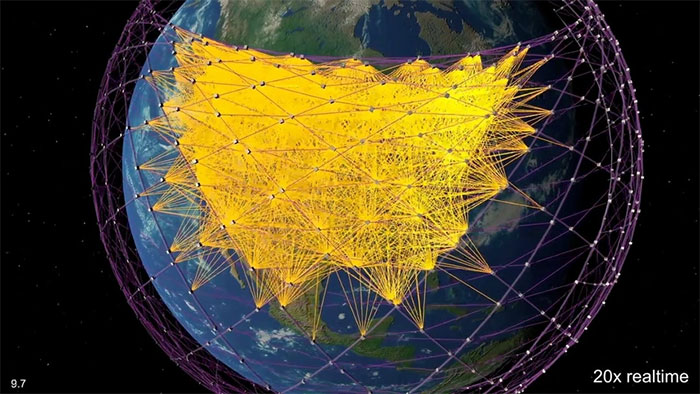
An illustration of Starlink satellites in orbit. (Photo: University College of London).
When it first launched, SpaceX said in an email to Starlink beta testers that it was expecting speeds of 50-150 Mbps, with some interruptions. But it has since gone beyond that, delivering much higher speeds to users.
Starlink even achieved connection speeds of up to 175 Mbps in freezing temperatures, high winds, and snow, according to SpaceX's 2020 test.
Expensive
With its superior advantages over conventional carriers, it is understandable that the monthly cost of using Starlink is not cheap at $110 per month. In addition, if you are a new subscriber, you will need to purchase additional disks and routers to connect to the satellite, which the company sells for $600.
This price has increased significantly since Starlink first launched its service. In October 2020, customers only had to pay $600 upfront for both the connection device and the monthly fee for this satellite Internet service. As Insider explains, the way to sign up for Starlink service is based on a "first come, first served" basis.
The high cost for individual users makes Starlink's business in developed countries not very promising. According to statistics, 96% of households in the UK have high-speed Internet. The same is true in the US and EU markets, where the number of households with high-speed Internet also reaches 90%.
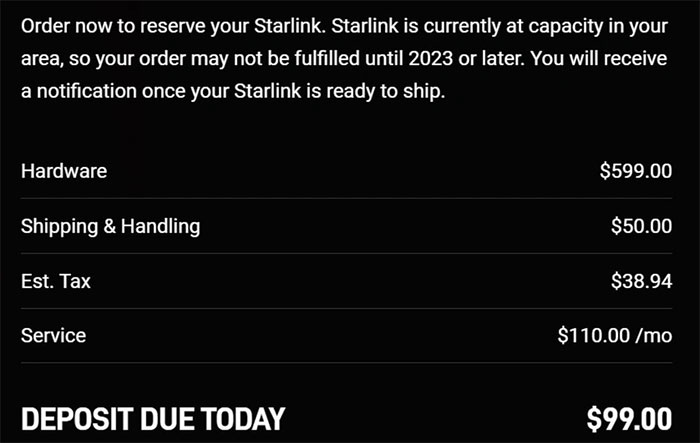
The monthly cost of using Starlink is not cheap. (Photo: CNET).
"Most developed countries in the world are already equipped with good enough network connections. Starlink is targeting a specific group of customers in the market to make a profit," said Professor Sa'id Mosteshar, Director of the Institute of Space Law and Policy, University of London.
A series of big companies want to cooperate
However, for large businesses that need an Internet network that can work anywhere, Starlink is the perfect solution.
Starlink has signed deals with major cruise industry players like Royal Caribbean, Hawaiian Airlines, and semi-private regional jet service JSX to provide Wi-Fi to passengers. The company is in talks with Delta and Frontier Airlines to further expand its reach in the skies.
In late August, US carrier T-Mobile said it would use SpaceX's Starlink satellites to provide better cellular service to Americans. T-Mobile will connect users' mobile phones directly to satellites in orbit.
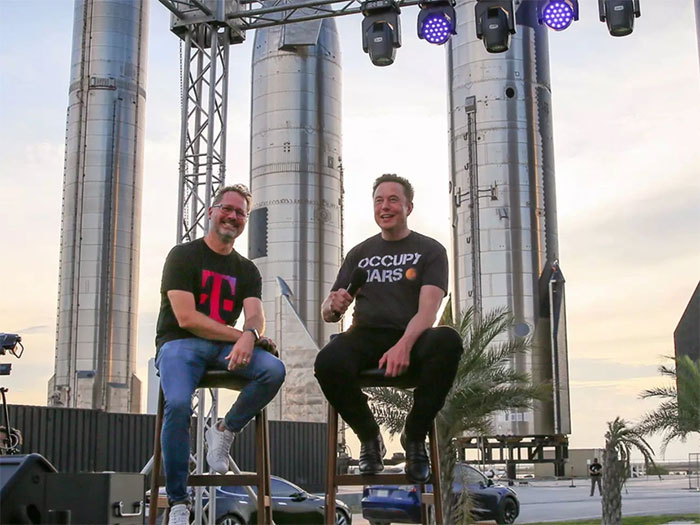
US carrier T-Mobile, in conjunction with Starlink satellites, promises to bring Internet coverage to every corner of the Earth. (Photo: Getty Images).
Speaking of which, Musk said Starlink satellites will use T-Mobile's mid-band spectrum to create a new network, so most of customers' devices will be compatible with the new service. It will begin testing with messaging services late next year.
On Twitter, SpaceX CEO wrote that Starlink V2 satellites can eliminate blackouts around the globe and provide better network connectivity.