In the early morning of March 4, Vietnam time, millions of people in many parts of the world have witnessed the total lunar eclipse - one of the rare and interesting natural phenomena.
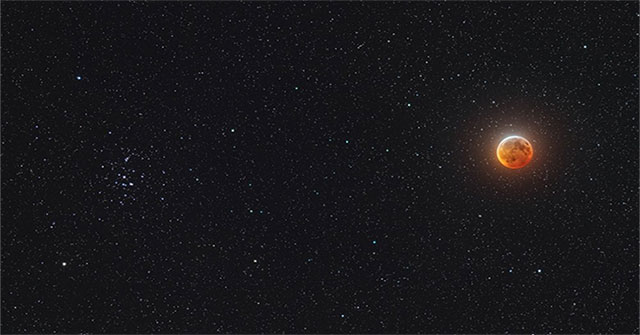
It took 6 hours, the shadow of the new earth completely moved through the surface of the moon. When the lunar eclipse occurred, the moon turned dark and red-orange made viewers imagine as " Sister Hang " turned into a star that was floating in the sky.
Regions that are capable of observing this phenomenon are Europe, Africa, the Middle East, parts of Asia and the Americas. While Eastern Australia, Alaska State (USA) and New Zealand did not have the opportunity to admire the eclipse on March 3, they will have the opportunity to witness their return on August 28 .
Below are beams of lunar eclipses, recorded at different locations around the world.

During the lunar eclipse, the entire moon was bathed in a golden light like the one Andrew Hutchinson had taken.

George Lovely took a series of movements of the moon and merged it into a sequence of images above.

This photo was taken by Francis Williamson in the Algarve, Portugal, showing a period of eclipse.

The moon is completely obscured at Canary Wharf, London.

In the photo of Alan Wadsworth, the earth blocks all the sun rays that normally reflect from the moon.

Far away from India people also see lunar eclipses, as demonstrated by Soham Shoney.

Gavin Clarke captured a colorful lunar image to celebrate his 41st birthday on the west coast of Sussex, England.

The moon looked like it was lit from the bottom in Matt Ohman's photo, 17 years old.

Andrew Cairns, in West Lothian, Scotland, snatched the red of the moon when full eclipse.

This picture by Ernst Schuetz was taken in Zurich, Switzerland, right after the full lunar eclipse.

Duncan Danks took pictures from his observatory in Gloucestershire, England.