Does the Earth have 1, 4 or 5 oceans? This seems like a simple question, but the answer has not yet been agreed upon by the scientific community .
Water covers more than 70% of the Earth's surface, and 96.5% of this water comes from the oceans. However, experts cannot agree on how many oceans there are on Earth.

According to the convention of international geographical associations recognized by the United Nations, the Earth includes 5 oceans: Pacific Ocean, Atlantic Ocean, Indian Ocean, Southern Ocean and Arctic Ocean. (Photo: Wallhere).
There is only one ocean
In theory, the blue planet has only one ocean because all oceans are part of an interconnected aquatic environmental system , according to the US National Oceanic and Atmospheric Administration (NOAA).
This water system is then divided into different regions , including four oceans: the Arctic, Atlantic, Indian, and Pacific . These four oceans are defined by the continents that border them.
In 2021, the National Geographic Society officially recognized the fifth ocean as the Southern Ocean, which surrounds Antarctica. But the answer to whether the Earth has one, four, or five oceans will vary from person to person.
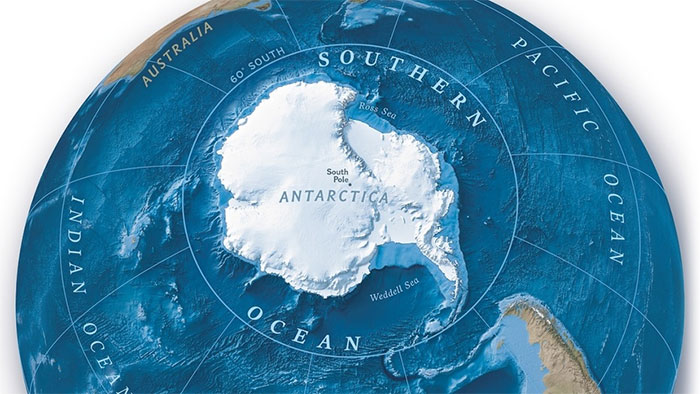
The Antarctic Current defines the boundaries of the Southern Ocean. (Photo: National Geographic).
The term ocean is commonly used to refer to large bodies of water on Earth. However, there is no official definition of the term.
The International Hydrographic Organization (IHO) did not recognize the existence of the Southern Ocean, which is bounded by the Antarctic Circumpolar Current (ACC) flowing from west to east. It was not until June 8, 2021 - World Oceans Day - that the Southern Ocean was officially recognized as the fifth ocean on the map.
Scientists believe that the Antarctic Current was formed 34 million years ago when the continent of Antarctica broke away from South America. This current circles the continent of Antarctica and defines the Southern Ocean as the waters south of 60°S latitude, except for the Drake Passage and Scotia Sea. The ACC is the dominant current of the Southern Ocean and is the largest ocean current today.
The Fifth Ocean Controversy
The waters of the Southern Ocean are colder and less salty than the southern Atlantic, Pacific, and Indian Oceans. Deep ocean currents that circulate around Antarctica are essential for marine life in the Southern Ocean.
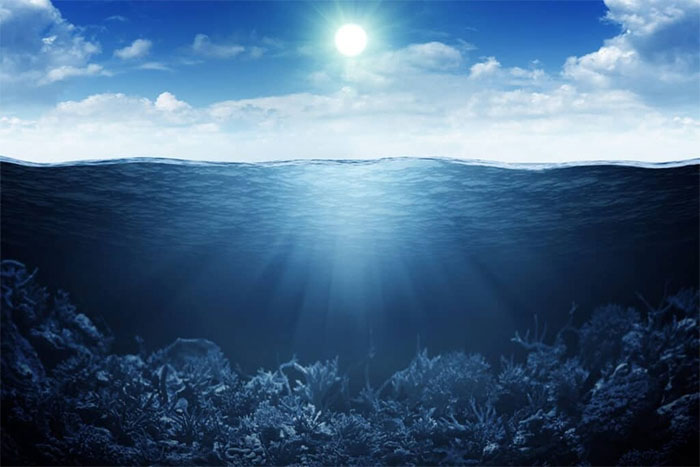
The Southern Ocean is known as the Earth's largest 'carbon sink'. (Photo: iStock).
They circulate water from the Atlantic, Pacific and Indian Oceans inward, distributing heat throughout the world. It can be said that the Antarctic Current acts as one of the lungs of the ocean, providing nutrients and new oxygen to 40% of the world's deep sea.
Ocean winds in this region are responsible for the upwelling of cold water that moves from the seafloor to the surface. Once on the surface, the water absorbs carbon and then sinks back down. This process has turned the Southern Ocean into the largest 'carbon sink' on Earth, according to a 2021 NASA study.
'The Antarctic Circumpolar Current is the connection point between the Southern Ocean and the other oceans ,' said hydrologist Frank Nitsche at Columbia University. The proposal to designate the waters around Antarctica as a separate ocean has been around for nearly 100 years and is widely accepted by scientists.
So Frank Nitsche said he didn't really care when the National Geographic Society decided to officially recognize the Southern Ocean as Earth's fifth ocean in 2021. "I didn't even notice it was recognized ," he told Live Science.
The question is, if scientists already know about this ocean, why is it necessary to name and recognize it? Explaining the problem, NOAA hydrologist Renellys Perez asserts that this will help the public better understand the problems facing the ocean area where they live.
'We like to think of all the waters as just one ocean, but it's much more useful to study them individually and address problems locally.
"People don't typically care about problems in the vast world ocean. Instead, they care about problems that are closer to their own region," the researcher told Live Science.