In the constellation Serpent, a bright object has just been captured by the James Webb Space Telescope, allowing Earthlings to witness "a moment of the future" with their own eyes.
James Webb , the world's most powerful space telescope developed and operated by NASA, has provided an unprecedentedly sharp view of Arp 220, a pair of merging galaxies 250 million light-years away.
According to Space, Arp 220 is currently a spiral shaped like the Milky Way galaxy that contains Earth, with swirling tails on the outskirts, which began the merging dance 700 million years ago and may continue for a long time after that.
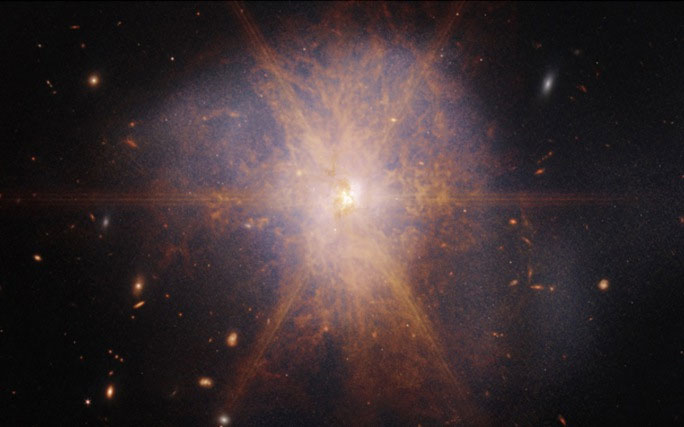
Merged galaxy Arp 220 - (Image: NASA/ESA/CSA).
As the Arp 220 galaxies began to merge, the abundance of gas and dust triggered intense star formation, much of which was concentrated in their dusty centers.
"The amount of gas in this tiny region is equal to all the gas in the entire Milky Way," the James Webb team describes.
More than 200 star clusters are packed into that area of just 5,000 light-years, causing the central star-forming ring to shine brightly, emitting a halo like a six-pointed star with each arm being a sharp, pointed band of light.
However, this massive star formation process suddenly stopped about 100 million years ago, causing the galaxy to enter a post-starburst phase.
Arp 220 was first discovered by NASA's more than three-decade-old Hubble Space Telescope in 2022, and then supplemented by NASA's Chandra X-ray Observatory.
However, with James Webb's "magic eye" , it was seen so clearly for the first time.
It is also a window into the future for Earthlings. The Milky Way, a "monster" among galaxies, will undergo a galactic merger in the next 2 billion years and 4-5 billion years. The first time will be with a dwarf galaxy, but the next time will be with a worthy "monster" - Andromeda, or Andromeda Galaxy.
The merger between the giant galaxies Milky Way and Andromeda will last for about 10 billion years, which will certainly result in the birth of many new stars. But it could also be the end of the world for Earth, as researchers predict that the collision could knock our planet out of the 'habitable zone' of the Solar System.