Scientists at UC Santa Barbara have discovered a protein called BAG2 that is important in understanding Alzheimer's disease and can open new goals for drug development. They are ready to switch from studying the bacterial implants to understanding their activity in mice.
In a recently published paper in the Journal of Neuroscience, the researchers describe the important activities of BAG2 in cleaning brain cells. Tau proteins are often found in brain cells, but scientists do not understand why it forms clutter in Alzheimer's patients.
The lead author Kenneth S. Kosik, co-director of UCSB's Neuroscience Research Institute and Professor Harriman on neuroscience, has been involved in studying neurons that break down into filaments messy, one of the signs of the disease. Kosik said: 'We are one of the few laboratories that detect tau that grows cluttered into small fibers.'
Kosik's group recently started working with BAG2 to find out how it might be involved in removing the tau disordered. Kosik said: 'When you inject this protein into a cell, it removes damaged tau easily'. It does not remove all tau, but only damaged tau proteins.
For unknown reasons, when tau coalesces into clutter, the cell cannot remove it. Kosik explained: 'All cells including nerve cells have complex and sophisticated systems to remove proteins. Protein has a certain turnaround time, sometimes they are often damaged. The cell has its own trash bin called proteosome, and the damaged proteins are concentrated there. '
Kosik continued: 'We do this experiment in many ways. We have discovered a part of BAG2 activity. We activate it to remove tau. We disable it to increase tau. We have made a lot of changes in bacterial cell use. BAG2 is a new factor, a new protein may be an important research target for Alzheimer's disease
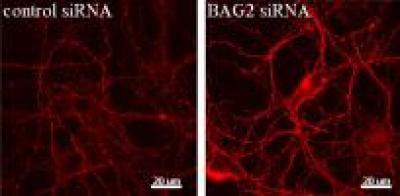 Image of neurons implanted in bacteria. (Photo: University of California - Santa Barbara).
Kosik said: 'There are no drugs or treatments in these findings, but the first step in fighting any of these diseases is finding a target for the drug to be developed. This is a protein involved in nerve fiber disorders, so we have a new goal for drug development. This is just a new goal and not a drug or treatment. The target is BAG 2 '. Kosik is looking forward to studying BAG2 in mice.
Kosik explained that we all have those proteins in our cells, however, they can be disordered. Their level may not be appropriate, or they misbehave in a different way.Normal protein may start to function incorrectly.
'Maybe BAG2 does not function properly, or BAG2 too much, because sometimes tau is formed, and there is not enough BAG2 there,' Kosik said. 'We cannot conclude that BAG2 is the basic problem for disease. It's just a goal that can help us fight this disease. '
However, the current project began when Kosik and the team suspected one of the problems of Alzheimer's is why cells cannot remove tau. They knew, even before the project started, that the cell had marked tau protein in Alzheimer's to eliminate it. There are markers on the protein at the nerve fibers disorders, indicating that this protein should be removed.This indicator is called ubiquitin.
Previously, Kosik's team discovered a protein involved in the decision to remove tau. This protein is called CHIP, and the team published information about it four years ago.
Kosik said: 'We already know something. CHIP has two functions. It informs the cell that there is a protein here at the critical moment. If the protein is restored, CHIP will become inactive and become a normal protein. If the protein is unable to recover because it is damaged by injury, then CHIP will operate and mark tau to remove by introducing some ubiquitin '.
The first two co-authors are Daniel C. Carretiero, postdoctoral scientist, and Israel Hernandez, graduate student. Both are molecular biologists. Co-author Pierre Neveu works in Kosik's lab, as well as UCSB's Kavli Institute of Theoretical Physics. Neveu brought some computing knowledge to reinforce the findings of the study.