New results from the world's most sensitive dark matter detector have narrowed down the range of particles known as WIMPs, a leading candidate for what creates the invisible mass in our universe.
Dark Matter and LUX-ZEPLIN (LZ)
Figuring out the nature of dark matter, the invisible substance that makes up most of the mass in our universe, is one of the biggest puzzles in physics. New results from the world's most sensitive dark matter detector, LUX-ZEPLIN (LZ) , have narrowed the search for one of the leading dark matter candidates: weakly interacting massive particles, or WIMPs.
Berkeley Lab with the LZ machine
LZ, from the U.S. Department of Energy's Lawrence Berkeley National Laboratory, has been hunting for dark matter from a cave nearly a mile underground at the Sanford Underground Research Facility in South Dakota. The experiment's new results reveal weaker dark matter interactions than ever before and further narrow down what WIMPs might be.
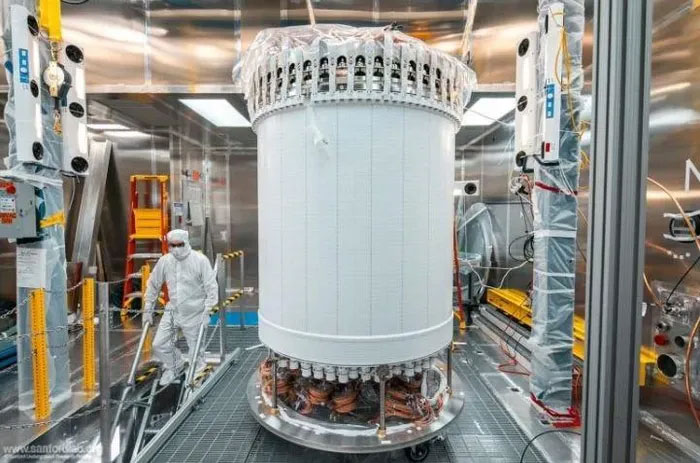
Berkeley Lab with the LZ machine.
Achievements and limitations of LZ
'These are the newest regions in the world with a significantly narrower range for finding dark matter and WIMPs,' said Chamkaur Ghag, LZ operations manager and professor at University College London (UCL). He noted that the analysis techniques and detectors are performing even better than the collaboration had expected. 'If WIMPs were in the region we were looking for, we would have been able to say for sure. We know that the instrument is sensitive enough to see if they are there when we look at lower energies.'
The collaboration found no evidence of WIMPs with energies above 9 gigaelectronvolts/c2 (GeV/c2). (For comparison, the energy of a proton is slightly less than 1 GeV/c2.) The experiment's sensitivity to weak interactions allowed the researchers to ignore potential WIMP dark matter models that did not fit the data, in favor of a more plausible hypothesis. The new results were presented at two physics conferences on August 26: TeV Particle Astrophysics 2024 in Chicago, USA, and LIDINE 2024 in São Paulo, Brazil.
Dive into LZ's Testing Methodology
280-day data analysis results: a new set of 220 days (collected from March 2023 to April 2024) combined with the previous 60 days from the first LZ run. The experiment plans to collect 1,000 days of data by the end of 2028.
Scott Kravitz, deputy LZ operator and professor at the University of Texas at Austin, compared: 'If you think about searching for dark matter like searching for buried treasure, we've dug almost five times deeper than anyone else has ever gone before. To dig that deep, you can't do it with a million shovels, you need to do it by inventing a new tool.'
Advances and techniques in dark matter detection
LZ's sensitivity comes from the myriad ways the detector reduces background noise , the false signals that can mislead or obscure dark matter interactions. Thanks to its deep underground location, the detector is shielded from cosmic rays from space. To reduce natural radiation from everyday objects, LZ is made from thousands of ultra-clean, low-radiation parts. The detector is built like an onion, with each outer layer blocking radiation to eliminate particles that mimic dark matter interactions. And sophisticated new analysis techniques help eliminate background interactions, especially those from the most common culprit: radon.
The result is also the first time LZ has applied 'salting'—a technique that adds fake WIMP signals during data collection. By masking the real data until 'unsalting' at the end, the researchers can avoid unconscious bias and avoid illusions or altering their analysis.
'We're on the cusp of entering a field of dark matter that people have never been in before, ' said Scott Haselschwardt, a member of the LZ team and now an assistant professor at the University of Michigan. ' People tend to want to see patterns in the data, so it's really important when you're entering this new field that there's no bias. If you're going to make a discovery, you want to make the right discovery.'
The importance of dark matter
Dark matter is so named because it does not emit, reflect, or absorb light . Dark matter is estimated to make up 85% of the mass of the universe but has never been directly detected, although it has left its mark on many astronomical observations. We would not exist without this mysterious but fundamental piece of the universe; the mass of dark matter contributes to the gravitational pull that helps galaxies form and hold together.
LZ uses 10 tons of liquid xenon as a dense, transparent material for dark matter particles to collide with. They hope that a WIMP will hit a xenon nucleus, causing it to move, like a billiard ball. By collecting the light and electrons emitted during the interaction, LZ will collect signals from the potential WIMP, along with other data.
'We have proven our power as a WIMP search engine and we will continue to get better and better, but there is still much more we can do with LZ,' said Amy Cottle, head of the WIMP search and assistant professor at UCL.
The next step is to use these data to look at other interesting and rare physical processes, such as the rare decay of xenon atoms, neutrinoless double beta decay, boron-8 neutrinos from the sun, and other physical processes beyond the Standard Model. So it's really exciting to explore some of these dark matter models that we haven't had access to in the last 20 years.'
Future directions and collaborative efforts
LZ is a collaboration of about 250 scientists and engineers from 38 institutions in the US, UK, Portugal, Switzerland, South Korea and Australia; much of the work to build, operate and analyse the record-breaking experiment is done by leading researchers. The collaboration is expected to analyse the next set of data and use new analytical techniques to search for dark matter with even lower masses. Scientists are also considering potential upgrades to improve LZ further and are planning a next-generation dark matter detector called XLZD.
'Our ability to find dark matter is improving at a rate faster than Moore's Law, ' said Kravitz . 'If you look at the exponential curve, everything before is nothing. Let's see what comes next . '
