There are theories that in the 1990s, the Soviet Union discovered about 20,000 pyramid-shaped ancient city ruins on Venus, which appeared to have been abandoned long ago.
Scientists say that Venus used to be a planet with conditions similar to Earth for life to evolve. With the rapid development of science, researchers have discovered that there are many forms of life, not necessarily carbon-based life. And there may also be life forms that can adapt to high temperatures.
In 2020, an article in the journal Nature Astronomy attracted the attention of people around the world, mentioning that there is a large amount of phosphine in the atmosphere of Venus, which means that there may be a lot of life on Venus!

From left to right are Mercury, Venus, Earth and Mars, we can see that Venus is almost the same size as our planet. In the past, Mars, Venus and Earth were all rocky planets, with surfaces made of solid metals and silicates.
The combination of these facts has many wondering, did an ancient civilization really exist on Venus? Where are they? Did they disappear or did they go to another planet? Or did they come to Earth? Is Venus the home planet of humanity?
Venus was a habitable planet in ancient times.
Venus's mass is 80% of Earth's mass, its volume is 88% of Earth's volume, and its radius is 6,073 meters, almost the same as Earth's radius of 6,371 meters. Therefore, Venus is also known as Earth's "sister star" .
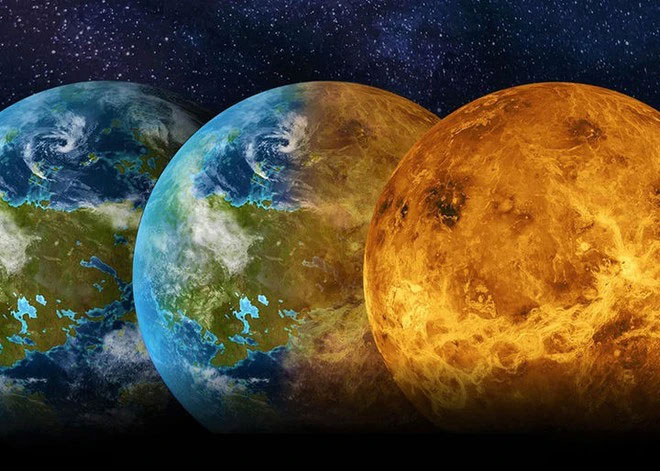
Astronomers speculate based on current signs on Venus and Mars that there may have been an ocean of liquid water on both Venus and Mars 4 billion years ago.
After NASA studied Venus, it was discovered that the temperature of Venus has been between 20°C and 50°C for 3 billion years and has a primitive ocean , which has conditions for the evolution of life.
At first, Venus had a magnetic field, but under the influence of some factors, Venus's magnetic field disappeared, and fierce solar winds continuously blew away hydrogen gas in Venus's atmosphere, while oxygen gas was retained on Venus because it was heavier.
Over time, water on Venus became less and less, the elements oxygen and carbon combined to create carbon dioxide, initially carbon dioxide was not a big problem, but when Venus' volcanic activity became strong, the huge amount of carbon dioxide inside "escaped" to the outside world, causing a strong greenhouse effect.
Eventually, Venus's greenhouse effect would have gone completely out of control, liquid water would have evaporated completely, and life would have been destroyed.
According to data returned by the Venus probe, the current concentration of carbon dioxide in Venus's atmosphere is as high as 96.5%, and the surface atmospheric pressure is 91 times that of the Earth. Under the influence of this extreme greenhouse effect, Venus has basically reached thermal equilibrium, and the average surface temperature is as high as 464°C.
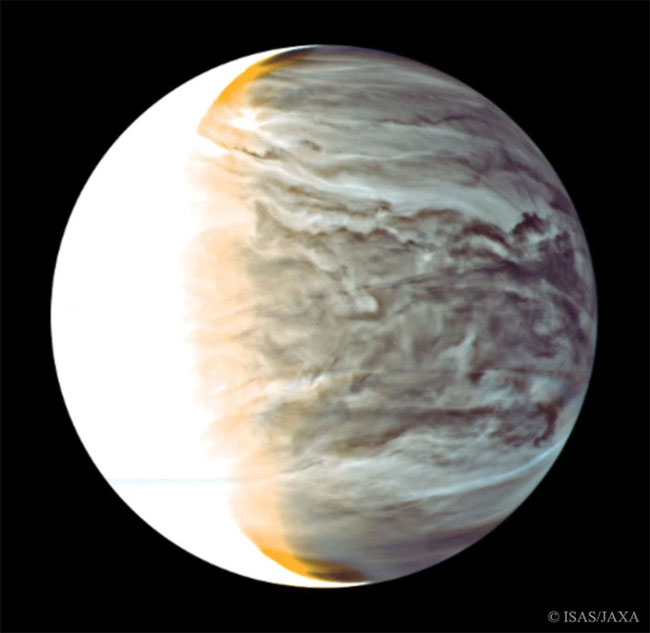
The Akatsuki Venus probe used an infrared camera to take pictures of the side of Venus facing the Sun.
Venus has a lot of phosphine, does that mean there is life?
This report was published in the journal Nature Astronomy in September 2020 and it received the attention of scientists because according to the current understanding of mankind, phosphine is a chemical compound between phosphorus and hydrogen that is closely related to life.
In addition to artificial synthesis, this compound is a product of anaerobic bacteria excretion. Taking humans as an example, after the human body is buried, anaerobic bacteria in the remains will produce hydrocarbons, hydrogen sulfide and phosphine during decomposition.
It can also be understood that phosphine is a product of the decomposition of biological remains.
At the time, many speculated whether life could exist on Venus. However, a new study has dismissed the possibility of life on Venus.
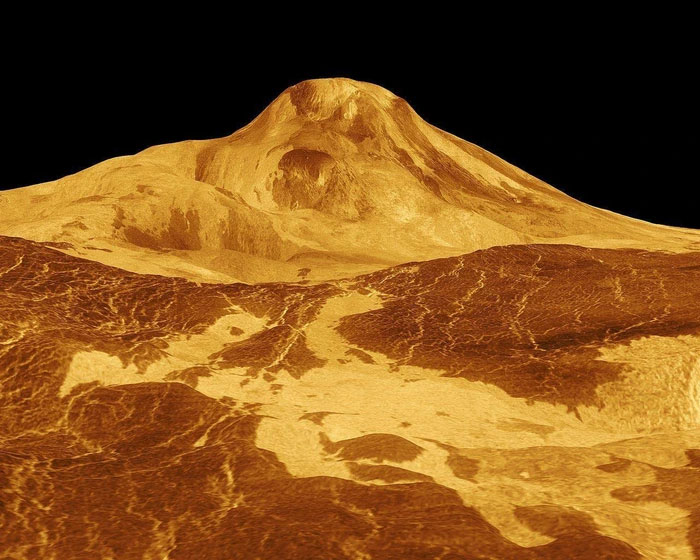
Venus is so hot that any spacesuit or lander ever built by humans would melt upon landing on the planet's surface. And so, until now, Venus has been considered our most mysterious "neighbor" .
"Phosphine on Venus is not biological evidence, but rather geological evidence of volcanic eruptions today or in the very recent past," said the author of the new study, Professor Jonathan Lunine .
The team explains that volcanic eruptions pushed small amounts of phosphide from the Earth's interior to the surface of Venus in the form of volcanic dust. This phosphide then reacted with sulfuric acid to form phosphine.
Radar images of Venus taken by NASA's Magellan spacecraft in the 1990s revealed several geological features that could support this theory, according to the team. Additionally, in 1978, during NASA's Pioneer Venus orbiter mission, scientists detected variations in sulfur dioxide in Venus' upper atmosphere, suggesting possible volcanic activity.
The Truth About Prehistoric Pyramids on Venus
In January 1989, the Soviet Union sent a probe to Venus. When scientists received radar scan images transmitted by the probe, they were extremely surprised because the photos showed that Venus had a large number of pyramid-like ruins.
These astrophysicists and imaging experts carefully examined the images and ruled out random factors like detector errors and interference from Venus' atmosphere. They determined that there are as many as 20,000 urban ruins on the surface of Venus!

The existence of prehistoric relics or life on Venus is just a product of the imagination.
However, these are just rumors and have no scientific basis . First, the Soviet Union never launched a secret Venus probe in January 1989. The historically verifiable Soviet Venus exploration program ended in 1984.
On December 21, 1984, the Soviet Union launched the Vega 2 satellite with a mission to explore Venus and Halley's Comet. Vega 2 landed safely and gently on June 15, 1985 on the Aphrodite Plateau of Venus after flying for half a year, and then the various instruments of the lander began to operate.
It found that the pressure on Venus at the landing site was 91 times Earth's standard atmospheric pressure - equivalent to the pressure at a depth of 900 metres in our Earth's ocean.
What's even more terrifying is that Vega 2 measured Venus as high as 463°C, and soon after, the Vega 2 lander was completely destroyed after working for 56 minutes in the harsh environment of Venus.
Judging from the images sent back by the Soviet probes "Venera 9" and "Venera 13" , there are no pyramid-shaped buildings on the surface of Venus.
Furthermore, Venus is often subjected to acid rain and fierce winds, so even if there were structures on the surface, they would not be able to stand for long. Scientists estimate that if we brought Earth's skyscrapers or pyramids to Venus, they would only be able to last for a few years, let alone being able to stand from ancient times to the present.