The SARS-CoV-2 variant first identified in the UK, B.1.1.7, may have come from dogs. The finding raises the risk of culling dogs in areas where B.1.1.7 is circulating.
Researchers in Shanghai have traced the early evolution of the B.1.1.7 variant, which has caused a new wave of Covid-19 infections in several countries, but they have found no trace of it in virus samples collected from people around the world, the South China Morning Post reported.

The B.1.1.7 variant was first detected in London and the neighboring county of Ken. (Photo: AP)
However, when they expanded their search to animals, they found some early forms of B.1.1.7 in dogs, including a sample taken in the US last July.
'Such precursor variants include most or all mutations of the original B117 variant in the Canidae population, and they may have re-infected humans after a period of rapid mutation,' Professor Chen Luonan and colleagues at the National Key Laboratory of Cell Biology wrote in a paper published on April 16.
The emergence of the B.1.1.7 variant has puzzled researchers. After being isolated from two patients in Kent, southeast England, and London in September 2020, it quickly became the dominant strain of SARS-CoV-2 in the UK and many other countries, spreading faster than previous strains.
Some experts believe the variant may have emerged from local communities under pressure from antiviral drugs used during the pandemic. According to a popular theory, it emerged suddenly in the UK and then spread to other parts of the world.
But the B.1.1.7 variant has nine distinct mutations that have rarely been seen in previous human strains, according to Chen and his colleagues. These mutations do not occur in adjacent genes, but are spread across the entire virus genome. The likelihood of all of these mutations appearing at the same time is extremely low.
The Shanghai team believes the nine mutations were created one after the other. Their model suggests the variant likely originated outside the UK and acquired the mutations in a non-human host. Dogs are the most likely suspects, followed by ferrets or cats.
However, Qu Liandong, a professor of virology at the Harbin Veterinary Research Institute who was not involved in the study, said more solid evidence was needed to prove the theory.
The strains found in the dogs are not exactly the same as the first strain identified in the British patient, Qu said. And although the number of genome sequences researchers have collected globally is in the hundreds of thousands, it is still small compared to the total number of patients there.
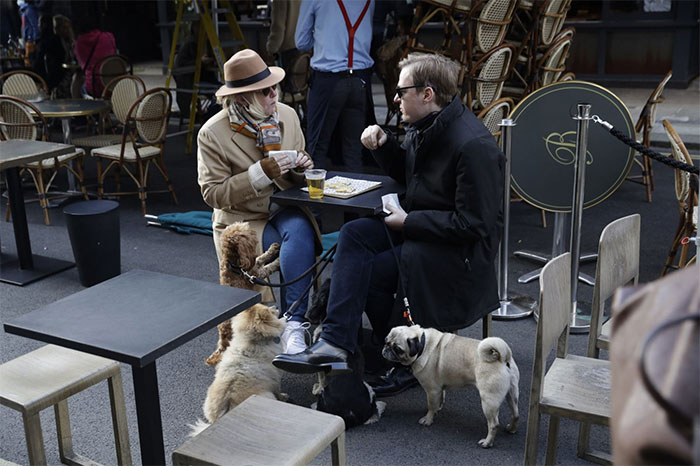
If dogs become hosts 'we're going to have a big problem'. (Photo: AP).
Professor Qu, who specializes in infectious diseases in humans and animals, said that if pets like dogs became hosts, 'we would have a big problem'.
'Almost all of our measures to combat the pandemic so far have been focused on humans. If animals are involved, it will be a complete game changer ,' he said.
When avian influenza breaks out on a chicken farm, all the chickens there must be culled, as is standard practice around the world. If the disease can infect humans, all susceptible animals – including healthy ones – must be culled in the affected area.
Dogs are close companions of humans, but if they are proven to be capable of carrying or producing mutant variants of the Sars-CoV-2 virus, they may also be culled, Professor Qu said.
One alternative is to vaccinate animals. 'But we can't give human vaccines to dogs. We might need to develop some completely new version. We've had trouble vaccinating humans. How can the program be extended to dogs or other animals?' - Professor Gu raised the question.
There are growing concerns that the B.1.1.7 variant could make dogs very sick. Veterinarians near London noticed a sudden increase in pets — including dogs and cats — suffering from myocarditis earlier this year, and many of these animals tested positive for the B.1.1.7 variant, according to a Reuters report in March 2021.
Another problem is that humans and animals have different immune systems, and it is often difficult for viruses to jump from one species to another. The SARS-CoV-2 virus is thought to have originated in bats, but it may have taken decades to adapt to humans. When and where it made the jump from animal to human remains unclear.
Professor Chen's team said the B.1.1.7 variant has a unique evolutionary strategy of increasing its infectivity, so it can spread more easily from host to host, but at the same time reducing the number of copies it makes in the host.
Whether this strategy helps the B.1.1.7 variant cross species gaps requires further study, the researchers say.