The microorganisms that live in the sea are clearly visible through images magnifying from tens to hundreds of times under a microscope.

Richard Kirby, a marine scientist in England, devoted his entire career to studying and photographing plankton.The doctor highlights the incredible diversity and the wonderful beauty of the group of marine plankton.

His photographs appear in Richard Kirby's book Ocean Drifters (translated as "The Floating World") by Richard Kirby.The tiny animals that are visible under a microscope with a large magnification show the diversity and abundance of marine microbial worlds, from onion-shaped eyes, big-eyed hairy legs to images Strange form of unicellular individuals.

They are usually floating microorganisms in water such as algae, larvae, bacteria that live in both freshwater and saltwater.

The doctor said that if you took a sip of seawater, you accidentally swallowed hundreds to millions of plankton.
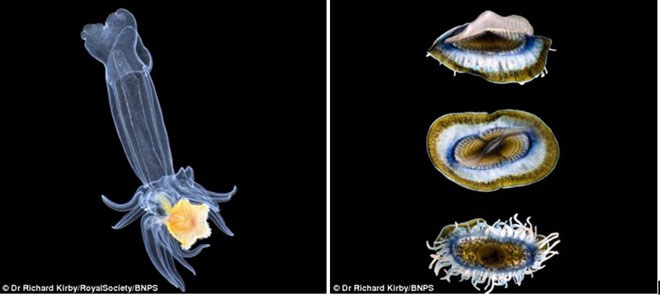
This is a picture of a larvae of seaworms and a jellyfish called Velella velella when Richard magnifies them 10 times under a microscope.

The enlarged face of a crab larva makes it look like a monster of the ocean.It has a length of up to 12mm and a transparent body.

A small, transparent, single-celled species with a tassel around.They often exist in large quantities in seawater .
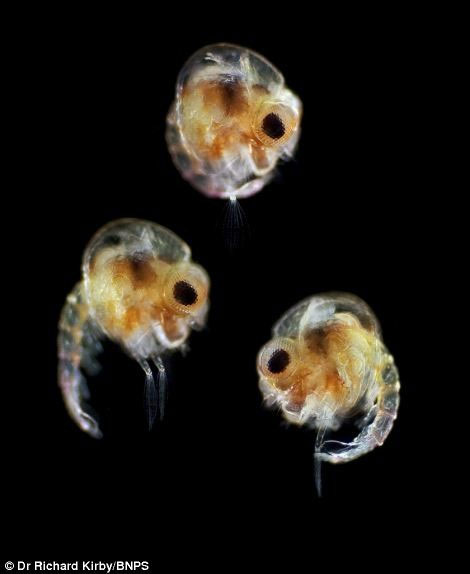
A kind of crab larvae when the microscope magnifies 150 times.

A clear picture helps us to observe every detail, shape, and fur of a lobster larvae.

Dr Kirby warns, global warming and warming ocean water are changing the habitat of organisms that change them both in density and distribution and seasonal changes.