Most celestial bodies orbit the Sun, and the mass is concentrated mainly in eight planets with nearly circular orbits and orbital planes that almost perfectly coincide, known as the ecliptic plane. What is the solar system? This is certainly a question that sparks interest, curiosity, and imagination in many people.
What is the Solar System?
The "Solar System" is "a planetary system with the Sun at its center and celestial bodies within the Sun's gravitational pull ," all of which formed from the collapse of a giant molecular cloud nearly 4.6 billion years ago.
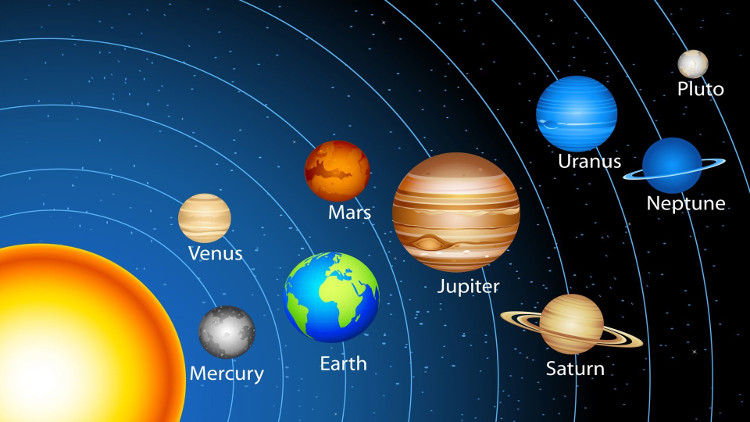
Our Solar System.
What is the structure of the Solar System?
The four innermost planets are Mercury, Venus, Earth, and Mars —also known as rocky planets because they are composed primarily of rock and metal. The four outermost gas giants are much more massive than the four inner planets.
The two largest planets, Jupiter and Saturn, are composed primarily of helium and hydrogen and are called gas planets , while the two outermost planets, Uranus and Neptune, are composed mainly of ice, such as water, ammonia, and methane, and are sometimes classified as ice giants .
There are six planets and three dwarf planets that have natural satellites orbiting them. These satellites are called "moons," after Earth's moon. Each outer planet also has planetary rings containing dust, particles, and small objects orbiting it.
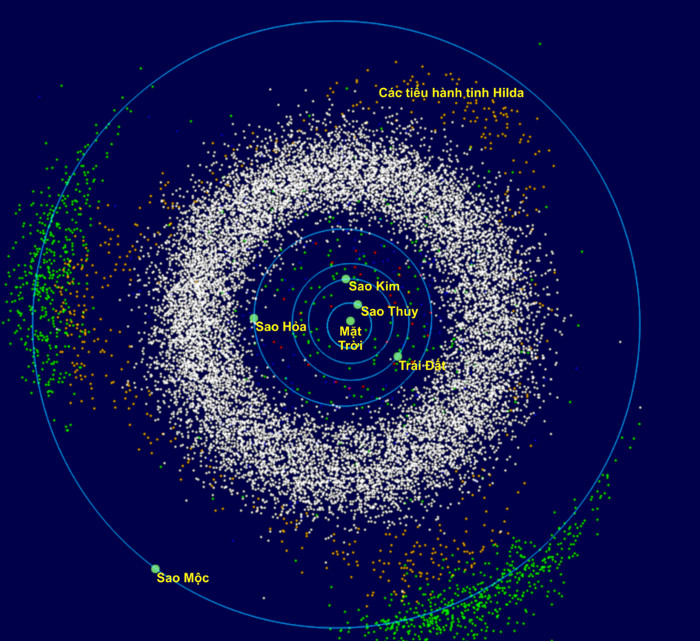
The Solar System also contains two regions of concentrated smaller celestial bodies. The asteroid belt , located between Mars and Jupiter, has a composition similar to rocky planets, consisting mostly of rock and metal. Beyond Neptune's orbit are the trans-Neptune objects, which are composed primarily of ice, such as water, ammonia, and methane.
Between these two regions, there are five typical celestial bodies in terms of size—Ceres, Pluto, Haumea, Makemake, and Eris—considered large enough to take on a spherical shape under the influence of their own gravity, and classified by astronomers as dwarf planets.

Additionally, thousands of small celestial bodies of varying sizes lie between these two regions, such as comets, centaurs, and interplanetary dust. they move freely between these two regions. The Sun emits streams of plasma matter, known as the solar wind , which creates a stellar wind bubble in the interstellar medium called the heliosphere , extending to the very edge of the dispersal disk. The hypothetical Oort cloud , considered the source of long-period comets, may exist at distances nearly 1,000 times farther than the heliosphere.
The principal celestial body in the Solar System is the Sun, a G2 main-sequence star containing 99.86% of the system's mass and dominating in gravity. The system's four gas giants account for the remaining 99%, and Jupiter's combined mass with Saturn's mass accounts for over 90% of the mass of all other celestial bodies combined.
Most large celestial bodies have orbital planes that closely coincide with Earth's orbital plane, called the ecliptic plane. Planets have orbital planes that lie very close to the ecliptic plane, while comets and objects in the Kuiper Belt often have orbital planes tilted at a large angle to the ecliptic plane.
All planets and most other celestial bodies orbit the Sun in the same direction as the Sun's rotation (counterclockwise, when viewed from the Sun's north pole). However, there are some exceptions, such as Halley's Comet, which rotates in the opposite direction.
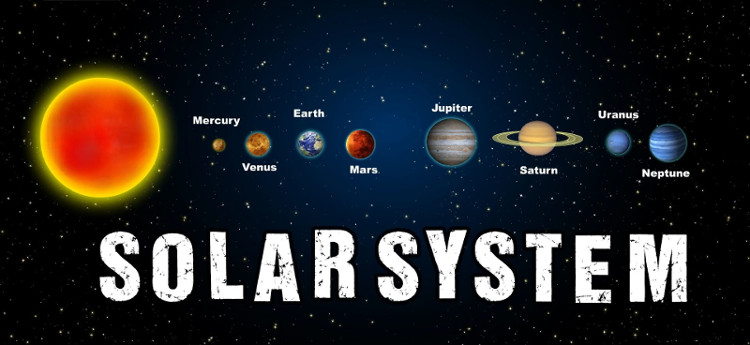
Most large celestial bodies have orbital planes that closely coincide with the orbital plane of the Earth, known as the ecliptic plane.
The overall structure of the regions within the Solar System is shown in the figure containing the Sun, four relatively small inner planets surrounded by a belt of rocky asteroids, and four gas giants surrounded by the Kuiper Belt containing icy celestial bodies. Astronomers sometimes informally divide the structure of the Solar System into separate regions.
In the Solar System, the orbits of the planets are nearly circular, while many comets, asteroids, and Kuiper Belt objects have very flattened elliptical orbits. The actual distances between the planets are very large; however, many illustrations of the Solar System depict the orbital distances of the planets as being equal.
In fact, the farther a planet or ring is from the Sun, the greater the distance between its orbits. For example, Venus is 0.33 astronomical units (AU) farther from the Sun than Mercury, while Saturn is 4.3 AU farther from Jupiter, and Neptune is 10.5 AU farther from Uranus.
Many attempts have been made to determine the correlation between the distances of planetary orbits (e.g., the Titius-Bode law), but no theory has yet been accepted.

Most planets in the Solar System possess a secondary system.
Most planets in our solar system have a secondary system, which consists of natural satellites or planetary rings orbiting the planet. These satellites are also known as moons. (Jupiter's natural satellite Ganymede and Saturn's Titan are even larger than Mercury).
Giant gas planets like Jupiter, Saturn, Uranus, and Neptune, and even a moon of Saturn, have planetary rings—thin bands of tiny particles orbiting them.
Most of the largest natural satellites orbit synchronously with one hemisphere always facing the planet. These inner celestial bodies are composed primarily of rock, a general term for compounds with high melting points, such as silicates, iron, or nickel, all of which remain in a solid state since their protoplanetary nebula stage.
Most of the largest natural satellites orbit in sync with one hemisphere always facing the planet.
Jupiter and Saturn are composed primarily of gas, an astronomical term for materials with extremely low melting points and high vapor pressures such as hydrogen, helium, and neon, which are always in the gaseous phase within nebulae. Ice, like water, methane, ammonia, hydrogen sulfide, and carbon dioxide, has melting points of up to a few hundred Kelvin, while its phase depends on the surrounding pressure and temperature.
They can be found as ice, liquid, or gas in many parts of the Solar System, while in nebulae they are only in a solid (ice) or gaseous state. Icy substances are the main component of the moons of gas giants, as well as making up a large part of the composition of Uranus and Neptune (called "ice giants" ) and in many small objects beyond Neptune's orbit. Gases and ice are collectively called volatiles in astronomy .