Fifteen times larger than a full moon from Earth's perspective, the ghostly object's appearance has upset the laws of cosmology .
If your eyes were a little more sensitive to light, you might have been shocked to see a giant structure consisting of a ring of light with an endless void in the middle like a big hole going straight into space, located near the constellation of the Hermit.
According to Live Science , the "cosmic hole" is a ring-shaped structure created by many galaxies and galaxy clusters , with an actual diameter of up to 1.3 billion light years and a circumference of 4 billion light years.
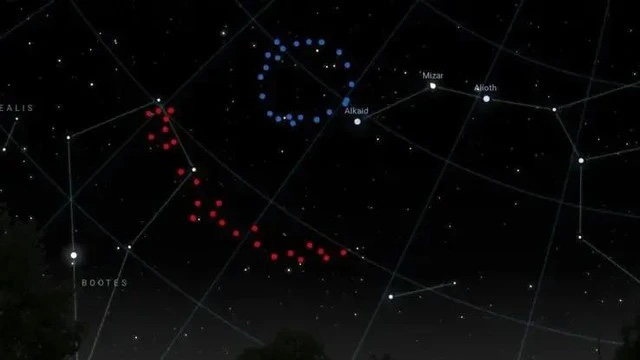
The "cosmic hole" is a giant ring made of galaxies and galaxy clusters, surrounding an endless void in the middle - (Photo: CENTRAL LANCASTER UNIVERSITY).
It is 9 billion light years away from Earth, but because it is so large, from the perspective of Earthlings, it still appears 15 times larger than the full moon. However, the light has faded so much over the long distance that you cannot see it with the naked eye.
Dubbed the Great Circle , this structure containing galaxies and galaxy clusters was discovered through the Sloan Digital Sky Survey.
In addition, the Great Circle also has a companion, the Great Arc , an object of the same type but with a bow shape, 3.3 billion light-years long and discovered since 2021.
Together, the two structures are among the most massive ever found in the universe and challenge the most fundamental laws of cosmology, according to a team led by Dr Alexia Lopez from the University of Central Lancashire (UK).
The authors explain that according to the cosmological principle, if you shrink the universe, it will all start out more or less the same.
This is thought to be because the laws of physics are identical throughout the universe, acting equally on all masses of matter within it.
Thus, a hard limit was set: Objects within it could not be larger than about 1.2 billion light years.
The Great Circle and Great Arc craters have both previously broken this. Why they exist remains a mystery.
"The Great Circle and the Giant Arc, individually and together, offer us insights into the universe and its evolution," said Dr. Lopez.