Millions of people in the Americas will be able to witness an interesting astronomical phenomenon on October 14, which is an annular solar eclipse (when the Moon is seen to cover the Sun).
Vietnam will be able to observe an annular solar eclipse in 8 years
An annular solar eclipse occurs when the Moon is so far from Earth that it completely blocks the Sun. This results in a ring of light around the Moon's disk. The Sun's corona cannot be seen during an annular eclipse. The path of the eclipse will begin in the Pacific Ocean, off the coast of southern Canada, and move across the southwestern United States and Central America, Columbia, and Brazil. A partial eclipse will be visible across North and South America.
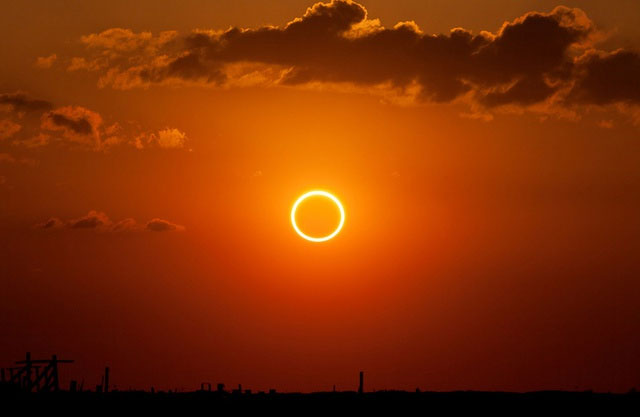
An annular solar eclipse is an interesting astronomical phenomenon that many people look forward to.
According to the Vietnam Astronomy and Cosmology Association, on October 14, some areas in the Americas will observe an annular solar eclipse . This is a phenomenon in which the Moon comes between the Earth and the Sun, but at a time when it is in an orbit far from the Earth (near aphelion), causing it to not completely cover the Sun, and therefore instead of a total eclipse, observers will see a part of the Sun exposed as a ring of light surrounding the Moon.
See also: Vietnam did not observe the first solar eclipse of the year.
Unfortunately, in Vietnam we will not be able to observe this annular eclipse. Apart from a few times with negligible coverage, only the southern provinces of Vietnam will be able to observe a significant eclipse in 2028. For the northern region, observers will have to wait until May 2031.
The Moon would appear to almost cover the Sun when viewed from Earth, but in reality the Moon is much smaller than the Sun, yet it is much closer to our planet. The Moon's diameter is 3,476 km, compared to the Sun's diameter of about 1.4 million km and the Earth's diameter of 12,742 km.
Experts warn that it is not safe to look directly at the bright Sun without using specialized eye protection designed for viewing solar eclipses. Because the Sun is never completely blocked by the Moon during an annular solar eclipse, it is unsafe to look directly at it without eye protection.
Amazing astronomical phenomena in October
According to the Hanoi Astronomical Society (HAS), October will see many interesting astronomical phenomena. The first is October 8 and 9 – the Draconids meteor shower . The Draconids is a small meteor shower that only produces about 10 meteors per hour. This meteor shower will peak on the night of October 8. The meteors will radiate from the constellation Draco but can appear anywhere in the sky.
On October 15 , the Moon will be on the same side of Earth as the Sun and will not be visible in the night sky. This phase occurs at 00:56. This is the best time to observe faint objects such as galaxies and star clusters because they will not be affected by moonlight.
October 20-21 The Orionids is an average meteor shower, producing up to 20 meteors per hour at its peak. It is produced by dust grains left behind by comet Halley, which has been known and observed since ancient times. The shower runs annually from October 2 to November 7. It peaks this year on the night of October 21.
Venus reaches its greatest western elongation on October 23. Venus reaches its greatest eastern elongation, reaching 46.4 degrees from the Sun. This is the best time to view Venus because it will be at its highest point above the horizon in the morning sky. Look for the bright planet in the eastern sky before sunrise.
October 29 is a full moon and a partial lunar eclipse. A partial lunar eclipse occurs when the Moon passes through a portion of the Earth's shadow, known as the penumbra, and only a portion of the Moon passes through the darkest part, known as the umbra. In this type of eclipse, a portion of the Moon darkens as it passes through the Earth's shadow. The eclipse will be visible across Europe, Asia, Africa, and western Australia.
