Astronomers discovered a small but extremely powerful black fire, with two heads emitting a stream of air that stretches 20 light years.
Lead researcher Roberto Soria of Curtin University (Australia) said that to observe the MQ1 black hole in the galaxy M83 , the team of experts including American and Australian astronomers has used a variety of the most modern tools. currently, from Hubble telescope, Magellan, Chandra X-ray observatory, Australian observatory and large telescope.
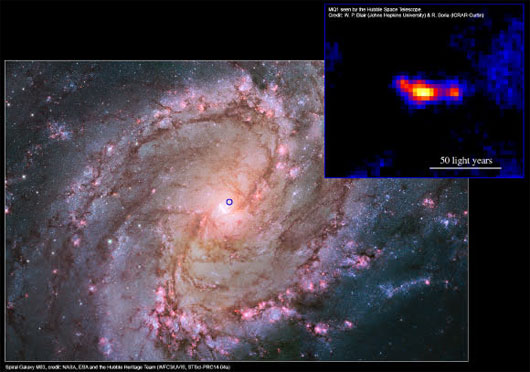
MQ1 is located in the middle of the galaxy M83 blue dot spot (Photo: NASA)
When analyzing MQ1 under normal light, radiation and X-rays, experts discovered that the black hole was smaller than it thought, with a diameter less than 100km.
The M83 galaxy is located about 15 million light-years from Earth, in the constellation of the Serpent.
Like the Milky Way, M83 is a spiral galaxy, and MQ1 forms when a star collapses, with a mass of 5 to 10 times the sun, according to Space.com.
According to expert Soria, MQ1 is a sub-standard, ie, a black hole absorbs matter from a companion star, and possesses two jet currents that emit material stretching across 20 light years.