Researchers estimate that the creature was about 20m long and weighed up to 340 tonnes, a mass that exceeds any other known animal on Earth.
Scientists on Wednesday unveiled the fossil of a whale unearthed in Peru called Perucetus colossus that lived about 38-40 million years ago - a creature that looked a bit like a manatee and weighed more than the blue whale, the heaviest animal on Earth. Its scientific name means "giant whale of Peru."
"The main feature of this animal is certainly its extreme weight, which shows that evolution can produce creatures with features far beyond our imagination," said paleontologist Giovanni Bianucci of the University of Pisa in Italy, lead author of the study published in the journal Nature.
The minimum mass of the Perucetus species is estimated to be 85 tonnes , with an average weight of 180 tonnes . The largest known blue whale weighed about 190 tonnes, with a length of 33.5 m.
Meanwhile, the long-necked dinosaur Argentinosaurus lived about 95 million years ago in Argentina and is ranked as the heaviest dinosaur, estimated to weigh about 76 tons.
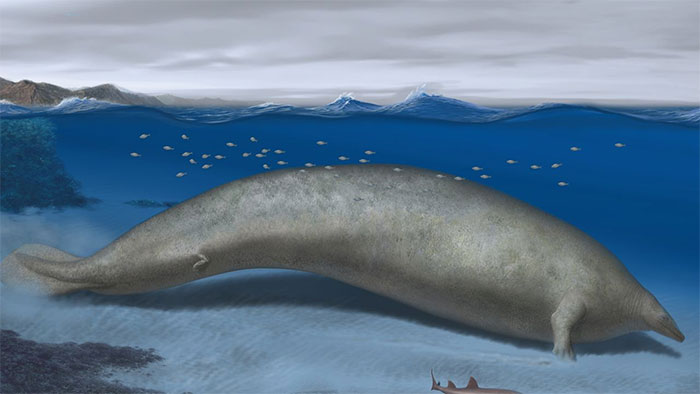
Image reconstruction of the species Perucetus.

Scientists unearthed a fossilized vertebra of the Perucetus species.
The fossil of a Perucetus individual was unearthed in the coastal desert of southern Peru - an area rich in whale fossils - with 13 vertebrae, four ribs and a hip bone. The paleontologists said the bone structure of this species was extremely dense and strong. This feature, called pachyosteosclerosis , is not found in marine mammals such as whales and dolphins, but is found in dugongs.
Its skeletal mass alone has been estimated at 5 to 8 tons, at least twice that of the blue whale.
"Its stout, bulky body may have resembled a dugong more than a whale. Among living dugongs, due to its enormous size and possibly similar lifestyle, Perucetus is most reminiscent of the Steller's sea cow, which was discovered in 1741 and more or less exterminated by humans a few years later," Bianucci said.
No skull or teeth were found, making it more difficult to interpret Perucetus' diet and lifestyle. Researchers suspect that Perucetus was not an active predator, but rather a bottom-feeder in shallow coastal waters . Perucetus likely fed on mollusks and small crustaceans on sandy bottoms.
"Because of its heavy skeleton and probably its very massive body, this animal was definitely a slow swimmer. To me, at this stage of our understanding, it looks like a kind of gentle giant, a bit like a supersized manatee," said paleontologist Olivier Lambert of the Royal Belgian Institute of Natural Sciences.
Whales evolved a little over 50 million years ago from hoofed, land-dwelling mammals about the size of a medium-sized dog. Perucetus still possessed vestiges of hind limbs.
Skeletal features suggest that Perucetus was related to Basilosaurus, another whale of similar length but smaller. However, Basilosaurus was a predator with an elongated body, powerful jaws, and large teeth.