The James Webb Space Telescope's latest observations of an ultracold region of space containing the building blocks of life are expected to help scientists understand how habitable planets form.
The James Webb Space Telescope, developed and operated primarily by NASA, with support from ESA and CSA (the European and Canadian space agencies), has set a new record by observing and collecting surprising indicators of the cold ice layer in the extreme depths of the Chameleon I molecular cloud .
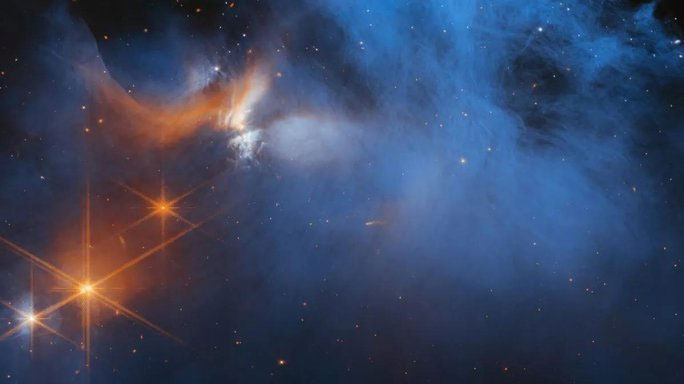
A thin blue molecular gas cloud with glowing spots from distant stars - (Image: James Webb/NASA/ESA/CSA).
According to Live Science, scientists used the James Webb infrared camera to peer into the extremely dark and extremely cold regions of this molecular cloud 500 light-years away.
They found some surprising things in a place where the deadly temperature is minus 263 degrees Celsius, just a hair's breadth away from absolute zero.
These are frozen molecules including carbonyl sulfur, ammonia, methane, methanol.
These familiar molecules will one day become part of the hot core of a newborn star, as well as part of exoplanets, many of which could be habitable, according to research just published in the scientific journal Nature.
They also hold the so-called "building blocks of life ," waiting to seed life when a suitable planet comes along: Carbon, oxygen, hydrogen, nitrogen and sulfur, a "molecular mixture of life" called COHNS.
"Our results provide insight into the initial dark chemical phase of ice formation on interstellar dust grains, which will grow into the centimeter-sized pebbles from which planets form," said lead author Melissa McClure from the Leden Observatory in the Netherlands.
Molecular clouds like Chameleon I are stellar and planetary nurseries. Over millions of years, the gas, ice, and dust inside them will form larger structures. Some of these structures heat up to become the cores of young stars.
As these young stars grow, they will pull more and more material towards themselves and become hotter and hotter, eventually forming a newborn star with a dense disk of gas and dust around it, where it will conceive planets.
"These observations open a new window into the pathways that form the simple and complex molecules needed to make the building blocks of life," added astronomer McClure.
James Webb is the world's most advanced space telescope, which NASA claims, in addition to its main mission of searching for worlds from the early universe - billions of light years away - can also help humanity search for life in places where astronomers are skeptical.