Scientific evidence published on April 9 has added a missing link in the evolution from the dark to the modern, writing a new chapter in the existence and development of mankind. .
Australian scientists have conducted research on two fairly complete fossil skeletons of a human-like species, scientifically named " Australopithecus sediba ."
The jelly flower was discovered in an almost intact state in a cave in South Africa in 2008.
The results show that these fossils belong to a "mature woman" and a "young 10 year old" dating back 1.78 to 1.95 million years.
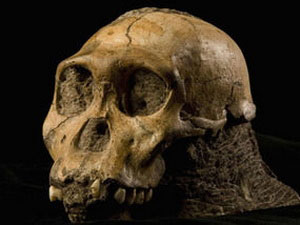
Fossil skull of a human-like creature, "Australopithecus sediba".(Source: dailyexpress.co.uk)
Fossils show that these two organisms are about 1.27m high and weigh about 27-33kg when they die, while their brains are one-third the size of modern human brains.
These two creatures have long gibbon-like arms but are shorter and stronger.
Their pelvis has evolved, their teeth are smaller and their legs grow longer so they can stand, walk straight, and even run like humans today, while still climbing like gibbons. .
Dr. Andy Herries, the leader of the research team, said this is the most important finding in the scientific awareness of the transitional phase in the development of the ancient people with a gibbon-like form (small brain) and line. The first breed of modern humans (scientific name "Homo habilis," has a larger developing brain).
This discovery is seen as the key to opening the secret door of the human transition from tree life to underground habitats.
The fossil is found in a small cave (formerly a mine) in the World Human Heritage site, an area of 500 square kilometers, 40km west of Johannesburg (South Africa) North.
This is also the place where many fossils were discovered related to the evolution of humanity in the world.
In the past, only a handful of "Homo habilis" fossils were discovered, in which most were just a few broken bones.
In the process of developing from ancient people to modern people, the scientific community knew of two famous ancient dark fossils "Lucy," which existed 3.2 million years ago and "Ardi," dating from 4.4 million years ago.