Data from NASA and ESA reveal a giant, extreme planet with the power to cause its neighboring star to rejuvenate and distort astronomical measurements.
According to a team of scientists led by Dr. Nikoleta Ilic from the Leibniz Institute for Astrophysics Potsdam - Germany, these are "hot Jupiters" located extremely close to their parent stars.
Hot Jupiters are a type of exoplanet that have been found quite a bit in the hunts of NASA, ESA (the US and European space agency) and several other space agencies, because they are very large and quite easy to observe compared to other types of exoplanets.
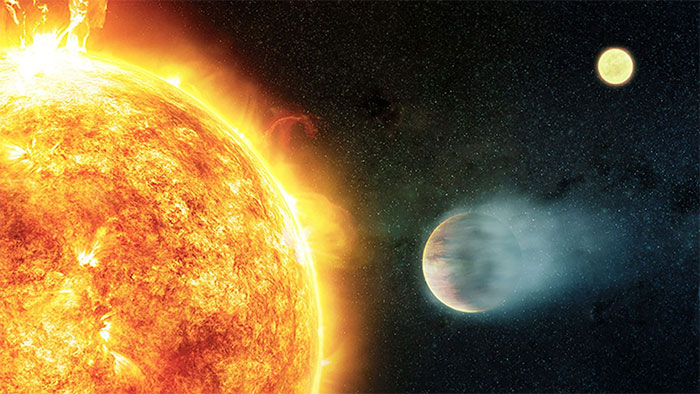
An illustration depicting a pair of binary stars, one of which hosts a hot Jupiter - (Image: NASA/CXC/M. Weiss)
These are gas giants, as large or larger than our planet Jupiter, but very hot because they are so close to their parent star. They are unlikely to support life, but are of great interest because of their strange properties and the possible influence on the formation of other planets in the system.
In new research, astronomers found that some calculations about star systems with hot Jupiters may be off because the parent star appears "younger" than usual.
"By comparing a star with a nearby planet to a twin star without a planet, we can study the differences in the behavior of stars of the same age," Sci-News quotes analysis from co-author Katja Poppenhaeger, also from the Leibniz Institute for Astrophysics Potsdam.
They looked at 10 pairs of binary stars from NASA's Chandra X-ray Observatory and six others from ESA's XMM-Newton observatory. The results showed that in each pair, the star with the hot Jupiter always appeared younger than its twin.
The reason is that the tidal forces of these hot gas giants are so strong that they act back on their parent star, causing the star to spin faster and become more active, like a way of stopping time.
Like humans, young stars spin fast and vibrantly, slowing down as they age. So if we only apply conventional observational formulas, we might mistake the 'mothers' of these hot Jupiters for being younger than they actually are.
The discovery points to the necessary changes in astronomical observations that scientists will have to take into account in their future studies of planetary systems with hot Jupiters, as well as adding an interesting piece to the puzzle of the hypothesis that planets can also regulate their parent stars in some mysterious and interesting ways.