Sunlight once shone on the dark parts of the moon. It is the result of experiments conducted by researchers at Edinburgh University by simulating the moon's millions of years of development.
Until now, everyone believed that the moon was formed after the earth collided with a large planet with Mars. The collision was so strong that the debris could have created a ghostly ocean of hundreds of kilometers deep covering the moon's surface.
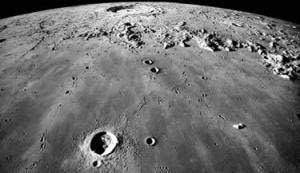
Moon surface.(Photo Sciencedaily)
But until now, no one could explain how this ocean of ghosts had cooled and how the topography of the moon changed to white plateaus and black valleys.
Moonstone is similar to volcanic black rock in the Canary Islands, in Spain. However, lunar slat has distinct characteristics due to the unusually high ratio of rare elements such as hafnium to tungsten.
To better understand this, the researchers created moon black rock based on the analysis of the stone samples taken from the Apollo spacecraft . The stones were melted in a furnace at a temperature of 1500 ° C. The researchers then tested them when they cooled and hardened to understand how the moon had hardened into stone.
Dr. Stephan Klemme of the University of Edinburgh School of Geology said: 'By studying how the crystalline minerals have helped us understand more about the geological history of the moon. Our experiments have shown that the minerals that have formed white rocks in the plateaus on the moon may have crystallized before. In contrast, iron-rich and heavy minerals may have sunk into the ghost ocean and formed more black rocks buried deep in the moon. '
He explains further: 'The reason the moon black rock is now exposed on the surface of the moon is the evidence of the meteor shower period later. The iron-rich minerals deep in the moon have been shown to be rich in hafnium and fewer tungsten elements and they may have erupted to the surface as molten rocks flow into the valleys on the moon to leave the shadow more black than we see today. '
(Photo: deviantart)
The Kiet
