If signs of Pluto's underground ocean have some scientists hopeful of life, the underground ocean in its moon Charon is a paradoxical hell.
Scientists from the Southwest Research Institute (SwRI) have investigated a rich and surprising dataset from NASA's New Horizons spacecraft to figure out the nature of the mysterious Charon object, once thought to be a bare ball of ice.
Previously in 2015, Charon's fascinating geological features shocked the scientific world when New Horizons - a Pluto research spacecraft - visited.
According to Space, the main shocker is evidence of an underground ocean , something astronomers always look for in celestial bodies in the hope of life.
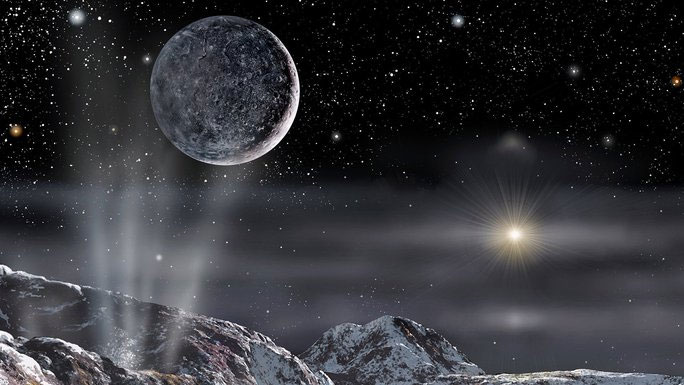
Charon seen from Pluto - (Graphic image from NASA/BBC)
But unlike the possible underground ocean of liquid water beneath Pluto's heart-shaped plain, which some scientists have speculated about and expected to be the site of an extreme form of life, Charon's underground ocean appears to be terrifyingly destructive to the celestial body.
If Earth's volcanoes spew out molten rock, Charon's icy ocean could find its way to the surface through "cryovolcanoes ," eruptions that resemble Earth's volcanoes, but spew icy material.
Not only that, but evidence suggests that this ocean was originally liquid, and then gradually froze as the Moon's outer shell formed. The ice has a larger volume than the water it's made of, so this ocean is what caused Charon's surface to crack—in other words, this "ice hell" literally broke the Moon.
Ocean-cut canyons on Charon's surface run along the global tectonic belt that separates the Moon's northern and southern geologic regions.
The above properties also help predict a sequence of geological activities related to the evolution of this mysterious Moon, as well as add a picture of a type of fate for celestial bodies with underground oceans.
The study of Charon also provides more data about Pluto itself, a celestial body that remains shrouded in mystery and whose status is unclear: the International Astronomical Union (IAU) maintains that it is only a dwarf planet, while NASA insists that it is "overqualified" for planet status.
New research on Charon has just been published in the scientific journal Icarus.