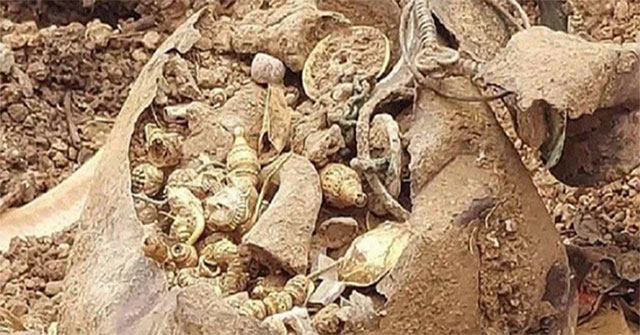
Egyptologists speculate that King Tutankhamun was relatively thin, walked with a limp, had a slightly elongated skull, and buck teeth based on his mummy, paintings, and statues.
100 years ago, on November 4, 1922, an archaeology team discovered the tomb of Pharaoh Tutankhamun , revealing many things about ancient Egypt, including the mummy of the young king. The discovery provided a wealth of information about Tutankhamun, who ascended the throne at age 9 and died at age 19. However, researchers still do not know exactly what this king looked like. Research has mainly examined King Tutankhamun's health, and there are several projects trying to reconstruct his portrait on computers, Live Science reported on November 2.
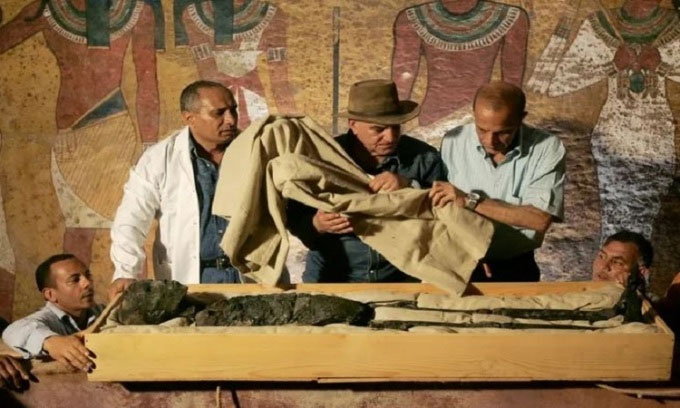
Zahi Hawass (center) removes the mummy of King Tutankhamun from his coffin. (Photo: Sarasota Herald Tribune)
A 2010 study of Tutankhamun and other mummies published in the journal JAMA concluded that King Tutankhamun was about 5 feet 6 inches tall when he died and suffered from a number of illnesses, including malaria and Köhler's disease , which caused his feet to swell and make it difficult for him to walk. He also suffered from gangrene (death of body tissue) due to a fracture in his left foot, which contributed to his death.
'Tutankhamun looked like a sick person,' said Zahi Hawass, Egypt's former antiquities minister and co-author of the JAMA study. 'He walked with a limp and used a cane.'
Despite his health problems, Tutankhamun remained very active. "The king loved to hunt wild animals and built a palace near the Sphinx for hunting," Hawass shared . "Despite any physical problems, he was so active that he had an accident and injured his leg two days before his death."
Hutan Ashrafian, a clinical lecturer in anatomy at Imperial College London, said that King Tutankhamun walked with a limp, had a slightly longer than normal skull and a large chest (due to gynecomastia caused by a hormonal imbalance), protruded teeth and was relatively thin . He looked quite frail.
In 2012, Ashrafian published a study in the journal Epilepsy & Behavior that showed that Tutankhamun and his ancestors suffered from epilepsy, which caused seizures. According to Ashrafian, some of his health problems may have been related to genetic diseases caused by inbreeding , since Egyptian pharaohs of the 18th dynasty often married relatives.
Scholars have been cautious about some of the attempts to reconstruct King Tutankhamun's face over the years. "There are still many uncertainties in the reconstructions, such as wrinkles, eye color, hair color, skin tone, and small scars," said Dr. Frank Rühli, head of the medical faculty at the University of Zurich. Rühli studied Egyptian mummies, including King Tutankhamun, and found that, on average, the mummy's tissue had shrunk by 53 percent compared to when they were alive. King Tutankhamun's mummy also had many changes compared to real life. For example, in ancient times, mummies often caught fire from embalming oil, making it extremely difficult to reconstruct the pharaoh's face. In addition, CT scans cannot reflect the shape of soft tissue before death.