In ancient times, a 100-tael check (paper money) would be worth 100,000 yuan (equivalent to more than 350 million VND). Faced with such high profits, why did almost no one dare to counterfeit in ancient times? How did the ancient government prevent counterfeiting?
Throughout its long history, China has developed many methods to combat counterfeiting and protect the value and reputation of its national monetary system. From the Song to the Qing dynasties, dynasties have used strict measures, from law to technology, to deal with counterfeiters.
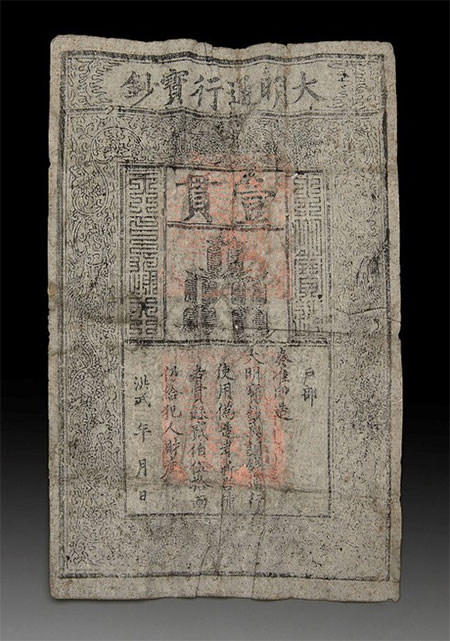
The patterns on ancient Chinese banknotes are too difficult to counterfeit. (Illustration photo).
First of all, we want to mention that the intricate patterns on ancient Chinese banknotes are too difficult to counterfeit . Ancient banknotes were tried to add patterns such as flowers, birds, insects and fish to increase the difficulty. There are even banknotes with very detailed dragon images, clear to every scale and whisker, if anyone has the idea of counterfeiting, they will definitely "collapse" when seeing these patterns.
However, temporarily ignoring the difficulty of these sophisticated motifs and patterns, there is something even more difficult, which is the material used to print money.
Ancient Chinese printed money often used special paper with specific thickness and material, which was unified, selected and issued by officials.
The second thing that also makes those who intend to make counterfeit money "shudder" is the severe penalties for those who issue and use counterfeit money .
Finally , one of the things that is almost impossible to counterfeit is the anti-counterfeit seal . To prevent counterfeiting of the circulating banknotes, the outstanding artisans of that time were specially invited by the royal courts to design sophisticated seals, which were strictly secured in extremely limited space. Something as simple as a poem of hundreds of words would certainly discourage anyone who wanted to counterfeit the banknotes and this seal.
Although technical measures can help prevent counterfeiting to some extent, when faced with talented counterfeiters, these measures can still be copied perfectly. During the late Yuan Dynasty and early Ming Dynasty, some counterfeiters were able to create counterfeit banknotes that were indistinguishable from genuine money, causing confusion in the market. In response to this situation, the dynasties developed signature stamp technology . This technology appeared in the Northern Song Dynasty and was mainly used for paper money circulation.

Some banknotes use micro-engraving techniques, which create designs so small they are barely visible to the naked eye. This is a major barrier to counterfeiters.
In the southwestern part of China during the Northern Song Dynasty, "banknote shops" appeared to hold large sums of money for merchants. Depositors could withdraw money using banknotes printed with "seals and signatures" as evidence. These signatures were special patterns or special signatures hidden on the banknotes, which were difficult to copy and had a long-lasting reputation. By the mid-Qing Dynasty, "seal signature" technology had been widely used, not only in the issuance of banknotes but also in commercial and financial transactions.
The fight against counterfeiting in ancient China saw great development and progress in both law and technology. From the imposition of strict legal measures to strict control of printing materials and the use of sophisticated technologies such as micro-engraving and signature stamps, ancient China built a strong defense system against counterfeiting. These measures not only protected the value of currency, but also maintained the stability of the economy and the people's confidence in the national monetary system.
