The oldest Egyptian mummy studied so far, will be introduced under all cutting classes early next year at a museum in Toulouse, France, with computer-generated reproduction techniques with three-dimensional images. .
Wrapped in layers of cloth, the mummy named Isis, "rested" from 3,800 years ago. So far, the identity of this Egyptian mummy is still unknown. However, for a few months now, people know what is hidden beneath the cloth although it is impossible to remove the cloth without damaging the mummy.
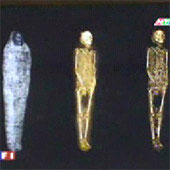 Scientists have had the initiative to virtualize mummies on computers. They put mummies in medical scanners to make two-dimensional cuts, ie models. As a result, they have 1,500 cutting classes, also 1,500 images. Each image is 1 mm of the mummy. From there, they arranged images to create blocks.
In this way, the mummy was discovered under every cut. Simply pressing the mouse is the layers of cloth that will disappear to reveal skin, bones and blood vessels, ligaments or muscles that are only partially shrunk by time. You can see paint stains on 1 toe. Thanks to this virtual regeneration technique, one can know more about mummies.
From January 2006, visitors to the museum in Toulouse (France) will be able to see mummies on the big screen or on the small screen. Explanatory films will let visitors know more about Isis mummies and special preservation measures for Isis to survive after 3,800 years of death.
3,800-year-old Egyptian mummy was exhibited in Toulouse (France)
The oldest Egyptian mummy studied so far, will be introduced under all cutting classes early next year at a museum in Toulouse, France, with computer-generated reproduction techniques with three-dimensional images. . Wrapped in fabric layers, the mummy is named l & a
Keep exploring
More in Science EventsBrowse the category
Next reads
Continue reading
Science Events
Binh Dinh wants to build a space research center





Science Events