These massive structures, resembling two submerged continents rising from the Earth's core, have baffled scientists for years and could be ancient gold and platinum from a "second moon".
According to Live Science , a new study has linked two giant "spots" in a stereoscopic map of the Earth to an ancient space collision in which one or more moon-sized objects, filled with gold and platinum, slammed into Earth.
This also explains the existence of these precious metals in our world, with only a small fraction having been mined by humans from the surface.
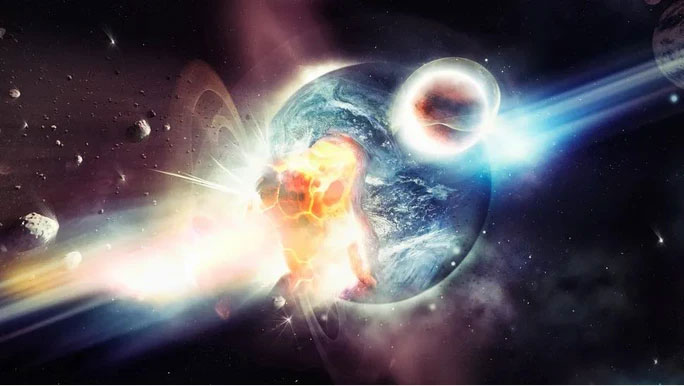
One or more moon-sized objects crashed into early Earth, leaving behind two mysterious "continents" at the bottom of the mantle - (Illustrative image from Live Science).
"These impacts could create large-scale areas with a slightly denser concentration of planetary material," said co-author Simone Marchi from the Southwest Research Institute (SwRI - USA).
Large space objects like the Moon, along with some smaller ones, have brought gold, platinum, palladium, and many other precious elements to Earth in abundant quantities.
With their high density within those objects, these very heavy metals pulled the dense region created by the impact gradually down into the planet's interior.
According to the SwRI researchers' model, the dense region where the space objects initially formed had the shape of a magma ocean different from Earth's magma. This ocean consisted of semi-solid, semi-molten rock.
Precious metals gradually permeate the semi-molten region, spreading outwards. Due to mixing and no longer being pure, instead of permeating into the core, these metals, along with the materials they mix with, reside in the areas where we find the mysterious "underground continents" we see today.
The paper published in the scientific journal Proceedings of the National Academy of Sciences also describes a history spanning billions of years of convection, during which metals were stirred up in the mantle, some of which were brought to the surface and trapped in the crust—these are the valuable gold, platinum, palladium, and other minerals that humans mine today.
The research results offer another interesting explanation for the "ultra-low velocity zone" —one beneath Africa, one beneath the Pacific Ocean—often referred to as the "spot" or "subcontinent" mentioned above.
These areas were discovered when numerous studies found that seismic waves passing through these regions slowed down, suggesting the presence of something unusual and denser in the core of the mantle.
Another widely supported theory suggests that it was the remnant of Theia , a hypothetical planet the size of Mars, that collided with early Earth 5.4 billion years ago, causing the matter of both to mix, creating the Earth and Moon we see today.