American scientists have found evidence that the remains of another planet inside the Earth have driven plate tectonics .
According to a study just published in Geophysical Research Letters, the planet hiding inside Earth is Theia , with a part that has not yet completely broken up forming "blobs" that geophysical data has identified in the area at the bottom of the mantle, just above the outer core.
Theia is a hypothetical planet the size of Mars that collided with the early Earth about 4.5 billion years ago.
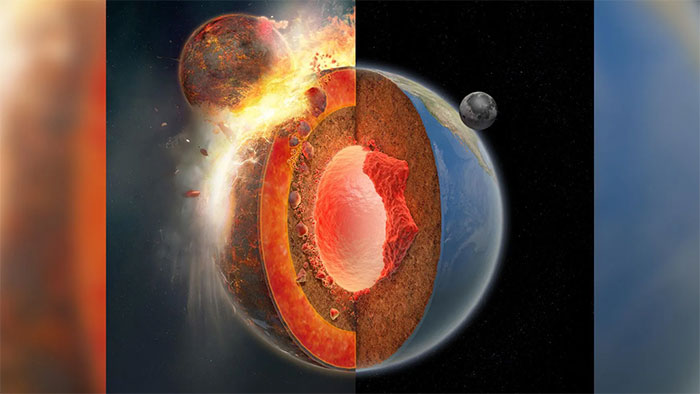
Graphic image with the left half showing the Earth-Theia collision in the past, the right half showing the current Earth with the Theia fragment near the core and the Moon born from the collision - (Graphic image: CALTECH).
The collision caused both young planets to break apart, most of Theia's material mixed with Earth, while a small portion was thrown into orbit, merging with debris from Earth, gradually condensing into the Moon.
The "blobs" from Theia - called LLVPs - are regions where the velocity of seismic waves becomes unusually low as they travel through.
In this new study, a team from the California Institute of Technology (Caltech - USA) used computer models to show what kind of impact LLVP could have had on the Earth's crust over millions of years.
According to a research summary in the scientific journal PHYS , models show that about 200 million years after Theia hit Earth, pressure from the LLVP led to the creation of hot plumes extending from near the core to the surface.
This caused some of the surface to sink, resulting in subduction. Subduction eventually led to faults on the surface that today serve as boundaries for tectonic plates.
Tectonic plates can be roughly understood as the crust of the Earth. It is estimated that there are about 20 large and small plates like this that are constantly moving. Some plates continue to move below due to subduction, while others slide and press on top.
Tectonic plates "carry" continents and oceans on their backs, so the process of plate tectonics causes the Earth's land to repeatedly merge into a supercontinent in the middle of a vast superocean, then separate as it is today.
Plate tectonics is also the main cause of many geological phenomena such as earthquakes, volcanoes, mountain building, formation of new ocean floors.
The researchers say their model could explain why some of the oldest minerals on Earth show evidence of subduction.