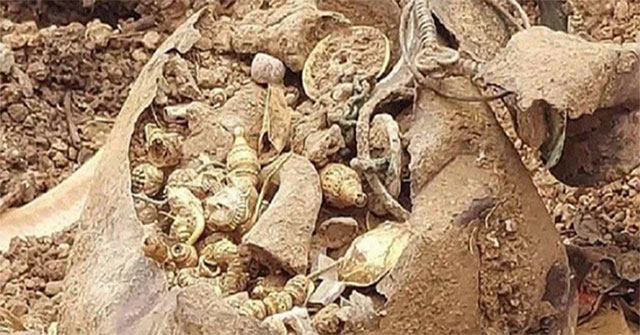
An ancient tomb recently excavated in Henan Province, China, not only brought a special coincidence on the Dragon Boat Festival but also revealed an "unbelievable" treasure.
Normally in a 2,000-year-old tomb, archaeologists only hope to find things that are difficult to decompose such as human bones, burial objects made of ceramic and metal.
But the ancient tomb that was just revealed on the occasion of the Duanwu Festival in Xinyang County, Henan Province, China, brought back a very unique treasure: 40 mysteriously intact dumplings . For archaeologists, it is a real treasure.

Ancient sticky rice cakes revealed on the occasion of the Duanwu Festival after being buried in an ancient tomb for about 2,300 years - (Photo: CHINA SCIENCE).
According to Xinhua News Agency, this ancient tomb belonged to a noble of the ancient Zhou state, during the middle of the Warring States period (475-221 BC), meaning the items in the tomb must be around 2,300 years old.
Pyramid-shaped banh ú, intact in shape and tied into strings, although the ingredients and "processing" are different, because they are made for the purpose of burying with the dead.
Microscopic examination showed that 39 of the 40 were stuffed with uncooked rice, still in its husk, while the remaining one was stuffed with a type of millet.
The leaves used to wrap banh ú are a type of oak leaf, still used to wrap this type of cake in the West and South of Henan province - China.
These are the oldest dumplings ever excavated, said archaeologist Lan Wanli from the Henan Provincial Institute of Cultural Relics and Archaeology .
Ancient dishes in good condition are a great treasure for archaeologists because analyzing them can reveal many details about a lost world: the agricultural situation, trade exchanges, customs, diet and health of the people living in the area.
Banh ú is a traditional dish during the Duanwu Festival in many Asian countries, although the ingredients and wrapping method may differ slightly from region to region.