China is the first country in the world to plant a flag on the Dark Side of the Moon, and to bring samples back to Earth .
China's unmanned Chang'e-6 probe is on its way back to Earth carrying the first samples from the far side of the Moon, a major achievement for Beijing's space program.
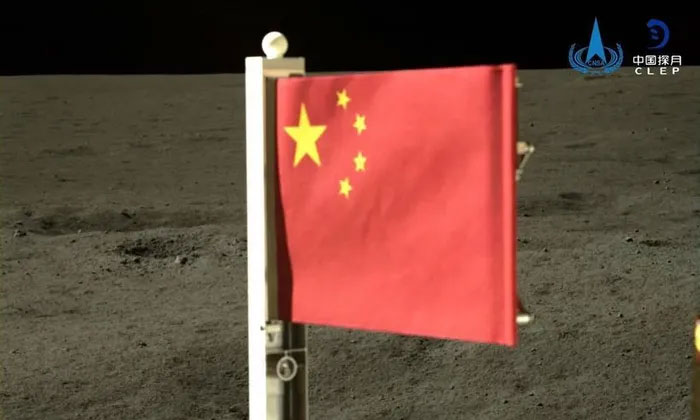
The Chang'e-6 probe plants the Chinese flag on the dark side of the Moon. (Photo: CNSA/EPA)
The probe landed on the lunar surface on Sunday, inside one of the oldest craters on Earth's satellite, called the South Pole-Aitken (SPA) basin . It then spent two days collecting soil and rock samples using its drill and robotic arm.
The China National Space Administration (CNSA) said that after successfully collecting its samples, 'a Chinese national flag carried by the lander was flown for the first time on the far side of the Moon'.
CNSA has confirmed the probe is on its return journey, with its ascent module having 'lifted off the lunar surface' and entered its pre-determined orbit around the Moon.
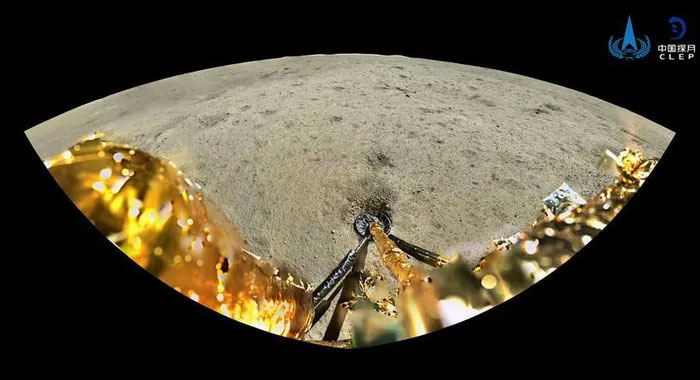
Image of the Moon's surface taken by the panoramic camera on the Chang'e-6 spacecraft. (Photo: AP).
This development has been welcomed by the scientific community.
'This is a very important achievement,' said Professor Martin Barstow of the University of Leicester.
'Only the US and Russia have recovered samples from the Moon, landed them and then taken them off again. It shows the impressive capabilities of China's space program. Taking off from the Moon is a technical achievement but it is even more difficult to do on the far side of the Moon.'
The far side of the Moon – also known as the Dark Side of the Moon because it cannot be seen from Earth – is said to offer new opportunities for research.
Experts say samples brought back by the probe could provide unprecedented insights into the formation and evolution of the Moon and the solar system, answer questions about why the near and far sides of the Moon are so different and provide clues about how Earth formed and how it sustains life.
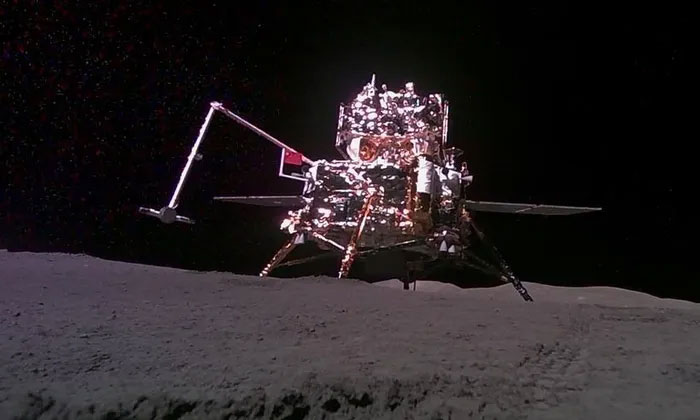
The combination of the lander and ascent vehicle of the Chang'e-6 probe rests on the lunar surface. This photo was taken by a mini-rover after it landed. (Photo: CNSA/Xinhua/AP)
'I don't know if they have plans to share samples outside of China, but I hope they do and we in the UK will have the opportunity to work on these samples. This would fit very well with our plans for getting samples from Mars,' said Professor Barstow.
Barstow said there was still a tense phase before it was truly successful, including docking the lunar vehicle with the lunar orbiter and then pushing the spacecraft back to Earth. But so far, the process has been very successful.
Chinese scientists expect the spacecraft to return to Earth to land in the desert of China's Inner Mongolia region around June 25.