Those who believe in the end of the world believe that on December 21, the Mayan calendar ended, which means humanity is perished. Others fear that the planets align in line with the earth causing a terrible disaster. The belief that comes from?
Rumors of apocalypse are largely based on speculation from the Mayan calendar, an ancient civilization that flourished in Central America. Before the decline, this civilization has left many outstanding achievements, including an astronomical calendar system with remarkable accuracy.
Unlike most other civilizations, the Mayans mainly use the base-20 counting system in making calendars. They group the days according to this counting system, just like today we group days by month, year, decade, century and millennium.
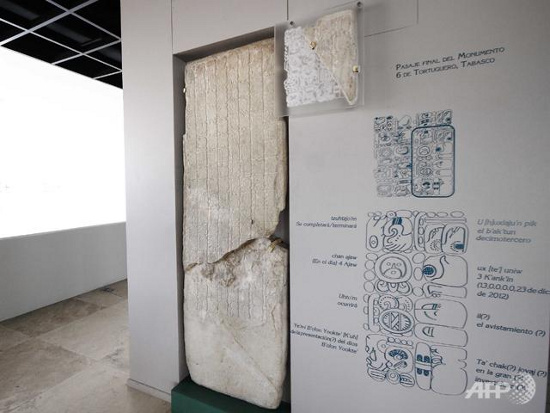
Stone calendar of Mayan people. (Photo: AFP)
Accordingly, 20 days is a winal, 18 winal is a tun, 20 tun is a katun, 20 katun is a baktun, so it will be piktun, kalabtun, kinchiltun and alautun. One tun only has 18 winal or 360 days, almost equal to one year. Thus, a baktun according to this calculation is about 394 years longer. From the information collected, the scientific community calculated backwards and found the starting point of the calendar on 11/8/3114 BC.
Another important figure of the Maya is number 13. Popol Vuh documents suggest that humans are living in the fourth era, beginning after the third era of destruction on August 11, 114, BC, after a cycle Large with 13 Baktun ends. Therefore, the above document believes that a similar event will occur on December 21, 2012 here. However, according to the schedule, the number of baktun will continue to increase to 20 to complete a piktun.
On the other hand, the Mayan civilization died in the sixteenth century and this calendar is no longer used. With time of existence and development less than 2,000 years, these concepts are still beliefs and conjectures. In the context of an isolated American civilization with the rest of the world, without access to advanced science and technology but heavy on mystical religion, that belief has no scientific basis for in 3114 BC or this year 2012. If the Mayan civilization still exists, they will probably wait until December 21 as a Tet holiday, but 394 will be one time, but merely the end of an old day and start a new day. .
The alignment of the planets
According to rumors, planets in the solar system align with each other and their gravity will resonate and affect the earth's movement.
The solar system has 8 planets and the probability of all 8 planets is extremely small. Dr. Donald Luttermoser, University of East Tennessee, USA calculates that all planets, from Mercury to Pluto (now into dwarf planet) will be absolutely aligned every 8.6.10 exponent 46 years (86 billion billion billion billion years, a much larger number of 13.7 billion years of the universe.
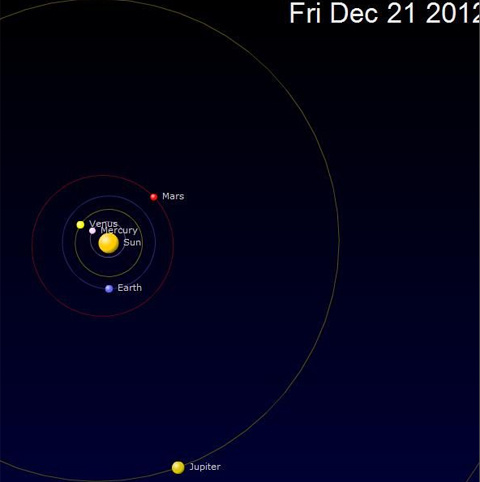
Simulate the real position of 5 main planets on December 21, reality
There is no way the planets are aligned. (Photo: abovetopsecret.com)
Historically, on February 4, 1962, the moon, the sun and planets from Mercury to Saturn were closer to 17 degrees in the sky. The next time this event happens will be the year 2,438. On December 21, 2012, there was no alignment of planets like this.
However, if the assumption is that all planets are aligned in one direction, then what effect does the earth have?
The sun and the moon have a gravitational force large and close enough to cause the tide on the earth, but that's because the sun is too big and the moon is too close to us. Gravity decreases with the square of the distance, the planets are too far away, not big enough to cause any significant impact on the earth. According to calculations, Jupiter - the largest planet in the surface system only affects one force equal to 1% of the moon. Meanwhile, in a lunar month, the moon changes the distance with the earth continuously, and therefore the tidal force fluctuates to 25%, too big for the other change.
There are also opinions that the alignment of these planets affects the sun. We must know that, the sun accounts for 99.86% of the total solar system mass, compared to all the remaining objects are too small, so whether it is aligned or not, interaction from all objects The rest to the sun is extremely small and cannot affect its inherent activity.
However, the planets are still "aligned" from the earth. This is an astronomical phenomenon common and known since ancient times.
Because the solar system is made up of a disk-shaped gas cloud, the planets have nearly identical orbits, seemingly lying on the same plane. If the plane of the Earth's orbit is standardized (the plane of the Zodiac), the planets moving in the sky are very close to the annual solar path (Zodiac line).
So, observing from the earth will see planets often lined up in the sky. However, in space, these planets are not aligned, but the image is only due to our observation direction from the earth.