Research shows that ancient lemming mice suffered a broken femur, most likely to die from falling from above.
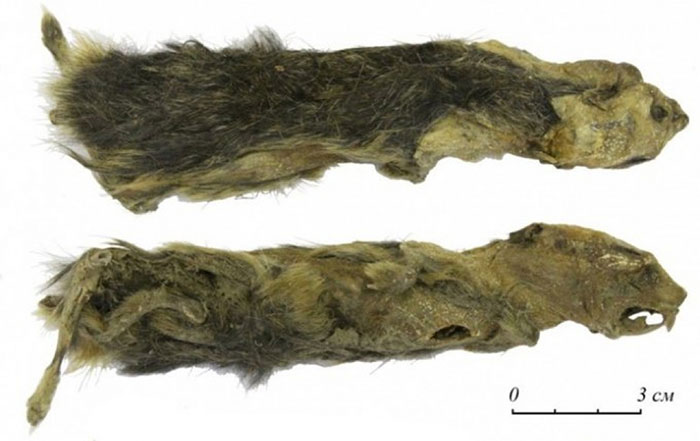
Lemming mice were found beneath the permafrost in Siberia.(Photo: Metro).
The Russian Academy of Sciences published photographs and results of the world's oldest lemming rat , Metro reported on December 28. A few years ago, while walking with her mother, student Angelina Sadovnikova accidentally discovered it under the cliff along Tirekhtyakh River , Siberia. After that, the mice were left to study biology by Nikita Solomonov and Vyacheslav Rozhnov.
Lemming mice suffer a broken femur and are more likely to die from falling from above. Thanks to the carbon isotopic dating method, scientists identified animals that existed more than 41,300 years ago. It is 16.5 cm long, a bit bigger than today's Siberian brown lemming mice.
Under the permafrost soil, the dead lemming remains well preserved for tens of thousands of years. It still has feathers on its back, stomach and sides, only hairless on its head. X-ray analysis revealed that the entire skeleton, including the skull, is well kept. However, the internal organs have completely decomposed.
The discovery of lemming corpses near the Tirekhtyakh River is extremely important in understanding the evolution of this group of animals in the Arctic. In addition to lemming mice, scientists have found mammoth, rhino, wolf and lion remains intact in the permafrost of Siberia.