A planet has just been confirmed as being as promising a place for the origin of life as the early Earth, if not more so .
A study just published in Earth and Planetary Science Letters creates the first model of the evolution of Mars' atmosphere , linking high temperatures during Mars' hot "infancy" to the creation of its oceans and primitive atmosphere.
Mars lies in the Solar System's Goldilocks habitable zone , but has long been known to be too cold and barren for life. Some circumstantial evidence suggests that it may not have been so in the past, but that planetary evolution - which is full of chance - has exhausted it.
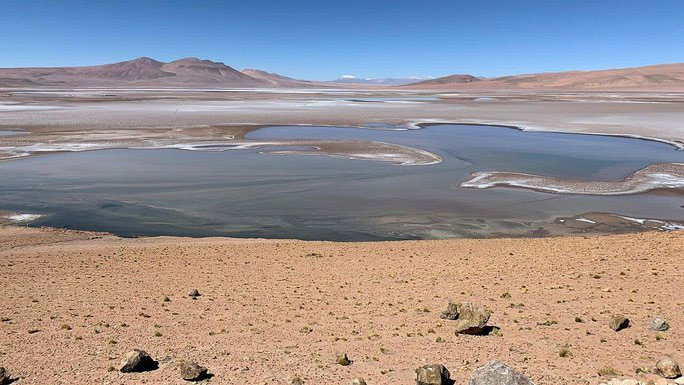
Mars was habitable in the past, perhaps even more habitable than Earth, according to researchers from the SETI Institute - (Graphic image from real data by Curiosity/NASA)
In the new model, created by the SETI Institute (the Search for Extraterrestrial Intelligence Institute, funded largely by NASA), the time period in which Mars formed its early environment is reconstructed using data collected by NASA's Curiosity rover, which is still exploring the red planet, as well as from Martian meteorites that have fallen to Earth.
Accordingly, the primitive atmosphere of Mars must have been about 1,000 times denser than it is today , consisting mainly of molecular hydrogen (H 2 ) in the upper atmosphere and abundant water vapor in the lower atmosphere.
"This finding is significant because H2 is a potent greenhouse gas. A dense H2 atmosphere would have created a strong greenhouse effect that allowed warm or hot oceans to be stable on the Martian surface for millions of years, until the H2 was gradually lost to space," the authors wrote in the paper.
This was determined through analysis of hydrogen isotope ratios in Martian meteorites as well as 3-billion-year-old clay samples collected by Curiosity.
What has just been shown is the perfect piece of the puzzle for a scenario of an early red planet with vast oceans, warm enough for life to arise thanks to the protection of the H 2 "armor" .
"This is the first model to reproduce these data naturally, giving us confidence that the atmospheric evolution scenario we have described corresponds to primordial events on Mars," said researcher Kaveh Pahlevan from the SETI Institute , SciTech Daily .
Unfortunately, H2 is easily lost into space, so after billions of years, this layer gradually thins, causing water vapor to escape, making the planet a cold, "dead desert" . However, it is clear that this planet was born to live.
Assessing the results from the model plus the planet's other habitable conditions, the SETI Institute authors concluded: " Early Mars was a warm version of modern-day Titan and at least as promising a site for the origin of life as early Earth, if not more so . "