Strange signals from deep inside the Earth have helped scientists identify a utopian world 3,000km below the surface, where silicon-rich snow is falling.
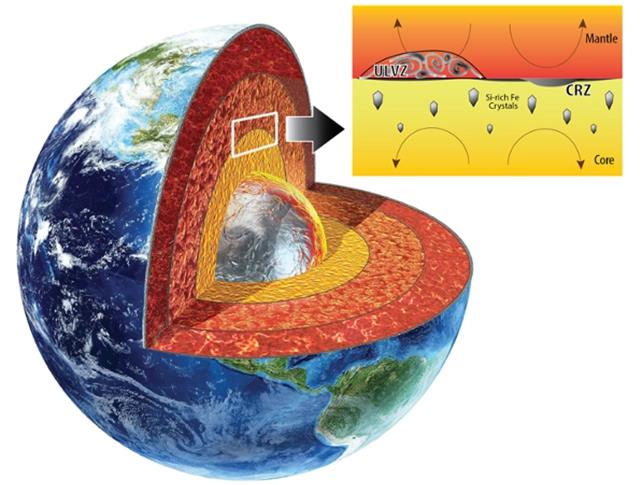
Graphic image depicting a world with "snow" falling inside the Earth - (Photo: TOKYO UNIVERSITY).
According to geologist Suyu Fu from the University of Tokyo (Japan), a member of the research team, they recreated the conditions inside the Earth's outer core in the laboratory to test the hypothesis of silicon "snow" falling back towards the mantle and depositing into strange "rivers" .
The skepticism stems from the fact that seismic waves picked up from deep within the Earth are often inconsistent. One of the places where this 'noise' occurs is in the low-density region about 3,000km below the surface, between the liquid iron-rich outer core and the mantle, according to a study cited in Science Alert.
New research suggests that if silicon and hydrogen are the two main light elements of the outer core, then snow-like material rich in silicon falling into the mantle could occur.
Laboratory results also show that under pressure and temperature conditions similar to the Earth's outer core, silicon-rich snow can form and "fly" up through the denser liquid iron layer to accumulate at the boundary, creating something that disrupts seismic waves.
The movement of the outer core drives our planet's magnetic field – a protective shield against harmful cosmic rays and solar weather. So a better understanding of this deep region, how it moves and interacts with the mantle, is crucial to predicting how Earth's magnetic field might behave in the future.
The study was recently published in the scientific journal Nature.