By reversing the model of cosmic evolution built upon humanity's vast astronomical knowledge today, a team of scientists has successfully discovered "giants" 10,000 times larger than the Sun.
According to Space magazine, today the greatest "giants " in the starry universe only weigh about ten times as much as our Sun. Such massive stars are extremely rare . But 13 billion years ago, their "ancestors" were completely different.
Astronomers have long understood how stars exist today, surrounded by chemically rich worlds similar to Earth: Over generations, stars die and leave behind an increasingly rich legacy for future generations, much like how all living things evolve.
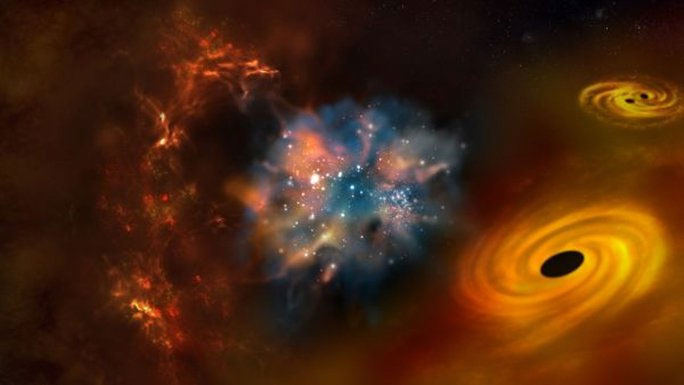
Graphic image of the wild early universe with giant supernovae, glowing monster black holes. - (Image: ESA).
To understand how the first stars were born, a team of scientists from the Graduate School of Science at Kyoto University and the Graduate School of Science at Tohoku University (Japan) used a sophisticated computer simulation to "rewind " cosmic time.
They chose to explore the "dark age," hundreds of millions of years after the Big Bang, when a new generation of stars was born "out of nowhere."
This computer model includes all the usual components of the universe: dark matter that helps galaxies grow, the evolution and agglomeration of neutral gas, radiation that can cool or heat gas, and more.
In addition, there's something particularly important for the first stars: streams of cold, fast-moving matter crashing into pre-formed structures.
They discovered a complex network that existed before the first generation of stars: neutral gas began to condense . The early universe was poor, consisting mainly of hydrogen and helium, but these were the substances that released heat, helping these neutral gas masses reach increasingly higher densities.
High-density clusters become very warm, generating radiation that breaks down neutral gas and prevents it from fragmenting into smaller clusters. Therefore, the stars born from these clusters are enormous, commonly about 10,000 times the size of the Sun, or 1,000 times the size of the largest stars today.
These would be extremely bright stars with extremely short lifespans, less than a million years. In a violent death as supernovae far greater than today's supernovae, these primordial "giants" began to pour into the universe the products they created from nuclear fusion in their cores—elements heavier than hydrogen and helium.
This cycle repeats continuously throughout the universe, and 13 billion years later, the universe possesses stars that are much smaller but contain an incredibly rich chemical composition, including many heavier elements.
But because the universe is full of heavy elements, neutral gas clusters never get hot enough or coalesce large enough to create giant monsters again.
The study has just been published online on the arXiv scientific database and is awaiting peer review by the Monthly Notices of the Royal Astronomical Society before official publication.