The chilling discovery of a huge amount of radioactive aluminium hitting the Solar System 4.6 billion years ago suggests the baby Earth had a narrow escape.
The chilling discovery of a huge amount of radioactive aluminium hitting the Solar System 4.6 billion years ago suggests the baby Earth had a narrow escape.
Scientists have found traces of an ancient supernova that would have blown up the Sun and its infant planets, if not for a molecular gas shield , according to Live Science.
A supernova is an object that appears to be a fairly round and bright molecular cloud, but is actually the remnant of a stellar explosion.
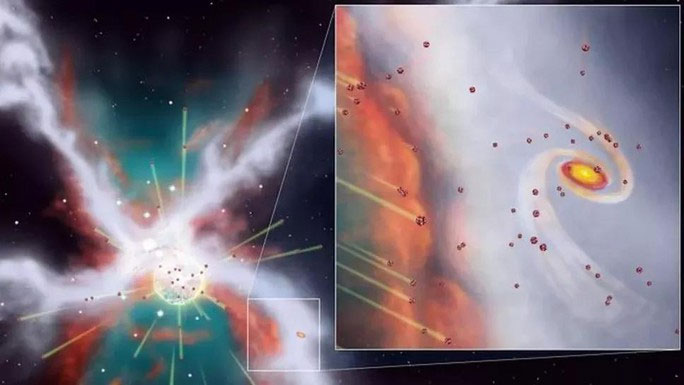
An illustration showing how the Sun and the protoplanetary disk that carried the infant Earth were protected from supernovae - (Image: NRAO).
It is one of the most terrifying "monster" objects in the universe with devastating shock waves and large amounts of material ejected around it, enough to cause disaster to planets many light years away.
Astrophysicist Doris Arzoumanian from the National Astronomical Observatory of Japan and colleagues found "monster footprints" in the earliest meteorites ever found: 4.6 billion years ago, they were unexpectedly enriched with large amounts of radioactive aluminum.
There is only one plausible explanation for the massive influx of radioactive aluminum into the Solar System: a supernova. Models show that this supernova was so close and powerful that it nearly blew up the entire star system, destroying its fledgling protoplanetary disk.
If that had happened as planned, the Earth might not have formed as it does today.
But the evidence also suggests a stroke of luck. Because the Solar System was so young, it still possessed a cocoon of molecular gas. This envelope inadvertently made the shockwave from the explosion and its ejecta less likely to hit the younger star system.
Not only the Sun, but other stars are born from giant filaments of gas in dense molecular clouds.
Large asteroid-like bodies formed in the first 100,000 years of a star's life also break apart, releasing radioactive isotope-rich meteorites and reinforcing this cocoon alongside the shell from the star's own gaseous filament.
This cocoon helps protect the entire system from the harsh effects of the universe such as supernovae or nearby hot and massive "monster" stars , which can negatively affect the formation of planets like Earth.
According to the authors, this unique discovery reveals how star systems containing habitable planets can safely form amid the harsh and chaotic environments of "stellar nurseries".