If they can't imagine, what would life be like for an invisible person? Can they dream? Can they remember their ex-lovers?
"Tell someone not to think of a pink elephant, and they will never forget it." This quote is from the 1974 novel "City in the Sky " by German writer Curt Siodmak.
Since then, this example has become a classic test for doctors, given to their patients, whom they suspect are suffering from a strange disease called "Aphantasia" , which roughly translates to "aphantasia syndrome".

Aphantasia comes from the Greek word " phantasia " which means "imagination". Adding the prefix "a", Aphantasia has the opposite meaning "unthinkable".
As the name suggests, people with anisocoria cannot imagine any image in their heads , whether it is a pink elephant, a memory they have experienced, the face of a loved one, their mother, their wife, or husband, and even their own face in the mirror.
So if normal people are asked not to think of a pink elephant, they will imagine a pink elephant, because of the "Romeo and Juliet effect" – the phenomenon where the more you forbid, the more you think.
The reason is that when you are asked not to think about something, your mind will always be alert to it and inadvertently make you think about it more.
Psychological experiments show that when you are asked to think of a pink elephant, your brain will imagine a pink elephant once every minute on average. Five minutes later, the frequency even doubles.
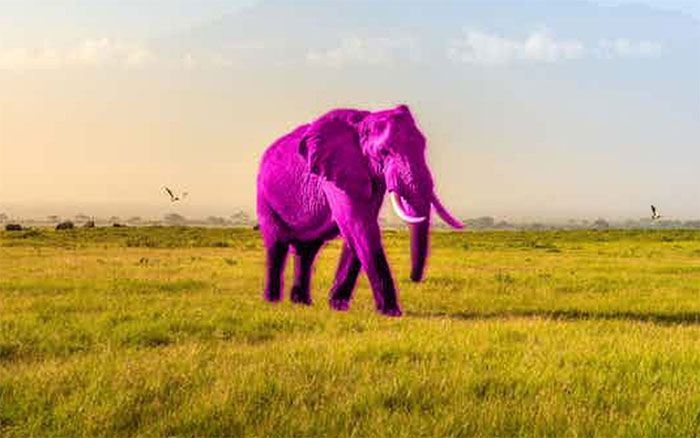
Ironically, people who were told not to think about the pink elephant imagined it twice as often as those who were told to think about it.
But that's for normal people. People with animagia simply don't imagine a pink elephant at all.
But why is that?
Anechoic hallucinations have been in medical literature since the 19th century, it was described in a scientific article in the journal Mind in 1880, but then it was forgotten and no one mentioned it again for more than a century.
It wasn't until 2005 that a team of scientists led by Professor Adam Zeman, a British neuroscientist from the University of Exeter, returned to study this phenomenon after accidentally discovering a patient who was unable to imagine images.
Professor Zeman is also the one who coined the term aphantasia. Since then, research on this syndrome has been conducted, helping scientists gradually lift the veil of mystery about one of the strangest syndromes on the planet, about the lives of patients who cannot imagine images and about the cause of the syndrome.

Approximately 0.8% of the population currently suffers from complete anomia.
According to a study in the journal Consciousness and Cognition, about 0.8% of the population currently suffers from complete anosmia and 3.9% of the population suffers from a mild form of anosmia , meaning they can still imagine images in their minds, but they are only blurry, unclear images.
The reason for this is thought to come from the brain's inability to convert visual information , including the shape, color, and depth of objects they see, into visual memories in their mind.
They can still see things like normal people, but are unable to remember them visually. In return, other features of the object such as sound, smell and feel will be recalled to help people with anechoic syndrome remember the object.
Scientists still don't know exactly what mechanism in the brain causes what they call "dysfunctional phasic processes ." Some people are born with anechoic dystopia, while others develop it after a traumatic brain injury, stroke, or as a side effect of certain medications.
If it is unimaginable, what would the life of an invisible person be like?
To find out, let's ask them directly, patients with Aphantasia syndrome. Niel Kenmuir, a 48-year-old man living in England, was born with this syndrome.

Kenmuir said he first became aware of his condition as a child. His stepfather told him to imagine sheep jumping over a fence and count them to help him fall asleep. But he couldn't.
" I couldn't see any sheep jumping over the fence. There was nothing to count ," said Kenmuir.
Sharing the same experience as Kenmuir, a woman named Serena Puang also shared: " When I was in primary school, I sometimes had trouble sleeping and people told me to count sheep. Although I had seen sheep jumping over fences in cartoons, when I tried to imagine it, I never saw anything - just black. I silently counted in the dark for many years."
While aphantasia can make counting sheep difficult, it doesn't seem to affect the creativity or imagination of those who suffer from it too much. Most people with aphantasia live normal lives and don't even realize they're different from other people.
Kenmuir, for example, worked in a bookstore and could still remember which books were on which shelves without having to picture them.
Can't imagine his wife's face
What many people will probably wonder most is if he could not imagine the image, even the face, of his wife, how did Kenmuir live with her?
" That's the hardest thing to describe, what goes through my mind when I think about things. When I think about my fiancée, there's no image that comes to mind, but I'm sure I'm thinking about her, I know she's wearing her hair in a bun today, her hair is brown. But I'm not describing the image that I'm seeing in my head, I'm just remembering her features," he said.

Niel Kenmuir, a 48-year-old man living in England, never imagined his wife's face.
Psychologist Wilma Bainbridge at the University of Chicago explains that this may be because people with anisocoria encode their memories entirely in words rather than images. For example, when Kenmuir thinks about his wife, he encodes her only in words like " brown hair," "blue eyes," "tall," "today," and "bun."
Aphantasia simply means that the visual memory cannot be retrieved, but the memory of the event, encoded in words, remains intact. However, sometimes the inability to remember images can be a bit difficult.
For example, Serena Puang, another anomia patient, started learning Chinese, she said: " While my friend, Shayley, found it easy. I asked her how she remembered the hieroglyphs, and she told me she just 'visualized the characters '.
To overcome the problem, she discussed her situation with her teacher, and he drew the letters on the board, analyzing the differences between them directly for Puang in real time. Since then, her Chinese learning has been going smoothly.
So can people with amnesia dream?
The answer is yes , but their dreams are also very different from those of normal people. People with anosmia can only dream of sounds, usually when they engage in imaginary conversations in their minds, such as talking to people in the dark or making phone calls without seeing their faces.

The dreams of clairvoyants often have a black background , according to their descriptions. In them, they can see themselves moving, walking through the sound of footsteps, cars, feeling the wind on their skin or blowing through the glass.
People with congenital anechoic dysmorphic disorder often consider their dreams to be completely normal from a young age, because they think that everyone else dreams of a black background like them. It is not until they are diagnosed and understand the problem that they have that they feel sad because they realize that other people can do things that they cannot.
For example, they also want to dream of a world as colorful as the real world they are seeing, imagine characters in a book, or visualize a loved one when they are not there.
But sometimes that's good too.
Studies show that people with anosognosia's inability to recall images in their minds means they are also less likely to be traumatized by recalling haunting images , or by recalling traumatic events from the past, such as a car accident or an ex-lover.
People with anomia cannot imagine images, so they are also more resistant to involuntary thoughts . A typical example is the "Romeo and Juliet effect" - the phenomenon of the more forbidden, the more unwilling, the more the thought.
This can give the mind of the person with no vision some peace . In stark contrast to a syndrome called Hyperphantasia, in which the sufferer is able to imagine extremely vivid mental images.

People with this syndrome are also less traumatized by recalling haunting images.
Although this allows them to experience mind games that normal people cannot do, for example, imagining themselves traveling "for free" to a luxury resort with an extremely realistic feeling, imagining themselves flying in the air, walking around the city or meeting idols, politicians in real life.
However, in contrast to people with no visions who are often carefree and worry-free, people with Hyperphantasia are often tormented and haunted by horrifying, terrifying or sad images more than normal people.
So, everything has two sides. Anomia is not necessarily bad, and the ability to have super-imagination is not necessarily good. If you have anomia, don't feel too bad about it.
Instead of imagining a pink elephant, you can focus on thinking about something more practical. Like what to eat for dinner.